Friends,
Over the past two decades, I’ve seen firsthand the profound impact a business owner’s death can have on a business. Inadequate business succession planning is still one of the main reasons why family enterprises to reach subsequent generations.
Without a clear plan, your business, your legacy, and your family’s financial security can face immediate and complex challenges, from operational paralysis to protracted legal disputes. Proactive estate and business planning is not merely advisable; it is a critical imperative for continuity and value preservation.
We decided to publish this comprehensive guide to help you understand the intricate dance between estate law and business continuity when an owner or key member passes away. Let’s dive in.
The Immediate Aftermath: Control, Authority, and Responsibility
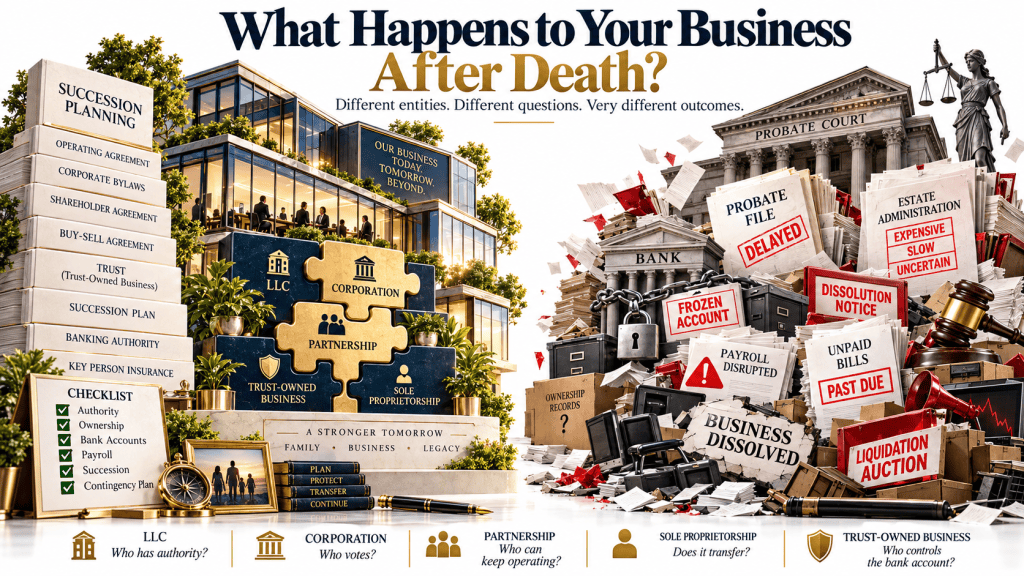
When a business member dies, the immediate questions often revolve around who has the authority to act and what happens to the business itself. The answer is rarely simple and heavily depends on the existing legal framework and the type of business entity.
Who Can Control the Business?
Without a robust succession plan, control can quickly fall into disarray. If the deceased was the sole owner, their estate typically becomes the new owner, and the executor or trustee steps in to oversee its fate. However, this doesn’t automatically mean they are equipped to run the business.
For multi-member entities, surviving partners or shareholders may find themselves co-owning with grieving heirs who have no operational experience or interest in the business, leading to potential disagreements and operational paralysis.
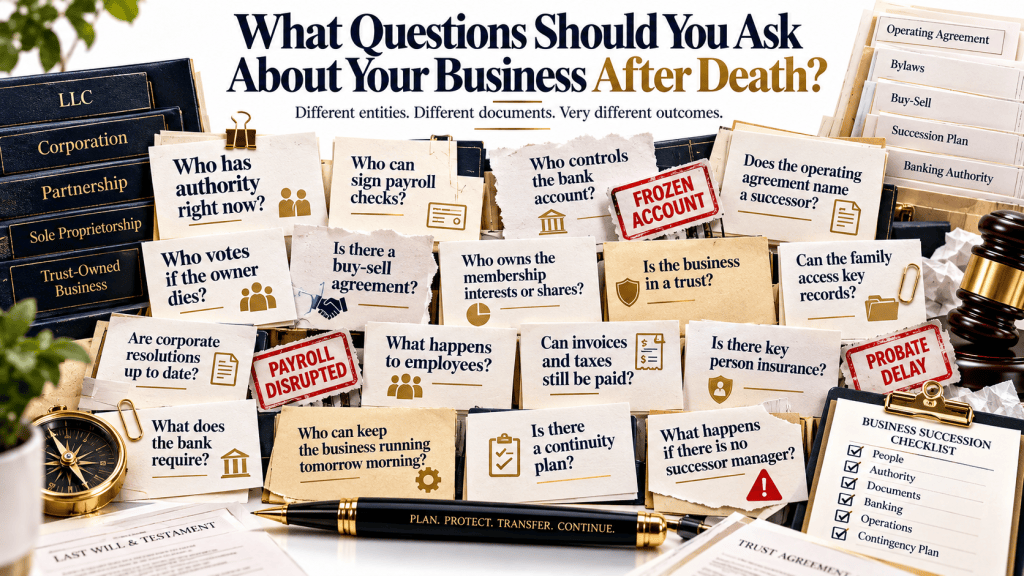
The authority to manage, sign documents, pay bills, sell assets, or simply preserve the business “as is” must be clearly delineated. A well-drafted contingency plan identifies decision-makers and provides necessary authorizations to prevent damaging delays.
Is the Business Part of the Estate?
Generally, unless it’s a sole proprietorship, the business itself is not considered part of the individual’s estate. Instead, the deceased’s ownership interest (shares, membership units, partnership interests) becomes an estate asset, subject to probate or trust administration. The executor or personal representative (PRs) has temporary authority to exercise shareholder rights during estate administration, making the selection of these individuals crucial for other stakeholders.
Understanding Your Business Structure’s Impact
The legal structure of your business significantly dictates the path of succession. Each entity type has unique implications for ownership transfer, continuity, and control.
Single-Member LLC:
- Estate Inclusion & Automatic Dissolution Risks: Upon the death of a sole member, 100% of the LLC’s membership interests pass directly into the deceased member’s probate estate. Under default state LLC statutes (such as RULLCA § 701), the death or dissociation of the sole member triggers mandatory administrative dissolution of the entity within a specified statutory timeframe (often 90 days) unless a successor member is formally admitted.
- Probate Freeze & Operational Paralysis: Pending probate administration and the issuance of court-issued Letters Testamentary, legal title to the membership interest remains in limbo. Lacking an authorized manager or living member, the company faces immediate operational freezes—banks often block account access, payroll processing halts, and contractual execution authority ceases until the probate court appoints a Personal Representative.
- Transfer on Death (TOD) & Direct Beneficiary Designations: To circumvent probate court intervention and state statutory default rules, an LLC Operating Agreement can incorporate express Transfer on Death (TOD) provisions or springing membership clauses. These provisions contractually designate a primary or contingent successor member, allowing legal and economic interest in the single-member LLC to transfer immediately to the named beneficiary upon death without going through probate.
- Springing Member & Interim Governance Provisions: A robust SMLLC Operating Agreement incorporates a designated “Springing Member” or special administrative manager. The springing member holds no economic or voting rights during the primary member’s lifetime, but automatically steps into a managerial fiduciary role upon the primary member’s death or incapacity, preventing entity dissolution and ensuring operational continuity.
LLC with S-Corp or C-Corp Election:
Entity Continuity & Estate Transfer
- Legal Entity Survival: Because LLCs and corporations are legal entities distinct from their owners, an LLC electively taxed as an S-Corp or C-Corp generally continues its legal existence following a member/shareholder’s death.
- Property Interest: An owner’s membership units or stock shares constitute personal property. Upon death, these pass directly to the deceased’s estate (or revocable trust, if pre-funded/assigned) to be managed by the executor or personal representative until final distribution.
S-Corporations & Permitted Shareholder Rules
Maintaining an S-Corp election requires strict adherence to Internal Revenue Code (IRC) § 1361 rules:
- Eligible Shareholders: S-Corp stock can only be held by U.S. citizens/residents, estates, and certain qualifying trusts—such as Grantor Trusts, Qualified Subchapter S Trusts (QSSTs), or Electing Small Business Trusts (ESBTs). Ineligible owners (such as corporations, partnerships, or non-resident aliens) immediately terminate the S-election.
- Deceased Shareholder’s Estate: The estate of a deceased shareholder is an eligible S-Corp shareholder under IRC § 1361(b)(1)(B). However, tax guidance emphasizes that estate administration must not be “unduly prolonged.” If the IRS determines an estate is open unreasonably long purely to preserve S-Corp status, it can reclassify the estate as an ineligible trust, disqualifying the S-election.
- Trust Timelines: If the shares pass to a grantor trust upon death, the trust remains an eligible shareholder for 2 years post-death under IRC § 1361(c)(2)(A)(ii) without requiring an immediate QSST or ESBT election. After 2 years, a formal QSST or ESBT election must be filed, or ownership must be transferred to an eligible beneficiary.
C-Corporations
- Unrestricted Ownership Eligibility: Unlike Subchapter S corporations, which enforce strict statutory limits under IRC § 1361 (capping total shareholders at 100 and banning non-resident aliens, partnerships, and corporations as owners), Subchapter C corporations face no federal statutory limitations on who may hold stock. Foreign nationals, commercial entities, irrevocable or business trusts, and estates are all fully eligible stock owners under IRC Subchapter C.
- Absence of Entity-Level Tax Forfeiture Risk: Because C-Corporations operate as separate, taxable corporate entities governed under IRC Subchapter C, transfers of ownership do not pose a threat to the entity’s tax status. Unlike an S-Election, which faces immediate termination upon transfer to an non-permitted shareholder, a C-Corporation’s tax status remains unaffected regardless of who inherits or holds the shares.
- Fiduciary Control & Shareholder Governance: Upon a shareholder’s death, legal title to the shares passes to the estate (or successor trust), while ultimate management authority rests with the personal representative (executor/administrator) or trustee. Under state corporate statutes (such as DGCL § 217), the fiduciary holds the legal right to vote the shares, inspect corporate books and records, consent to major corporate actions, and participate in shareholder meetings pending final distribution to beneficiaries.
- Economic Rights & Dividend Distributions: The estate or successor trust retains full economic rights associated with the stock. Any dividend distributions declared by the board of directors during administration are payable directly to the estate or trust. Tax-wise, these dividends constitute income in respect of a decedent (IRD) under IRC § 691 or estate/trust taxable income under IRC § 641, rather than altering the corporation’s tax liabilities.
Incorporated Businesses (Inc.)
- Perpetual Existence & Legal Entity Continuity: A corporation possesses an independent legal personality distinct from its shareholders. Consequently, an owner’s death does not trigger entity dissolution or operational cessation; corporate existence continues unabated by operation of law.
- Title Vesting & Probate Administration: Equity interests (stock certificates) constitute personal property. Upon a shareholder’s death, legal title to the shares vests automatically in the court-appointed Personal Representative (PR), executor, or administrator. In the absence of a valid Last Will and Testament, default state laws of intestate succession govern ultimate beneficiary entitlement under probate court oversight.
- Governing Document Precedence: Corporate charter instruments – specifically the Articles/Certificate of Incorporation and Bylaws – along with Shareholder Agreements, take statutory precedence regarding transfer restrictions, right-of-first-refusal clauses, and mandatory buyout options triggered upon an owner’s death.
Partnerships
- Default Statutory Dissolution Risks: Under the Uniform Partnership Act (UPA § 31) and Revised Uniform Partnership Act (RUPA § 801), the death of a general partner in an agreement-less partnership serves as an automatic event of dissociation or entity dissolution, legally compelling the surviving partners to wind up affairs and liquidate business assets.
- Fiduciary Claims & Liquidation Demands: Without restrictive provisions, a deceased partner’s estate representative lacks authority to participate in management but retains a strict legal claim to the economic value of the partner’s account, giving them standing to force a court-ordered accounting and asset sale.
- Contractual Overrides via Partnership Agreements: Partners can explicitly contract out of default statutory dissolution rules by executing a Partnership Agreement. A properly drafted agreement establishes continuation covenants, cross-purchase buyout mechanics, and binding valuation formulas to buy out the deceased partner’s economic interest.
Nonprofits
- Emergency Succession Planning: A formal emergency succession plan designates acting leadership roles, emergency executive committees, interim banking/signatory authorities, and stakeholder communication protocols to maintain mission integrity, satisfy grant compliance, and prevent operational paralysis during a key-person vacancy.
- Absence of Equity Ownership: Nonstock, nonprofit corporations (governed under state nonstock corporation acts and IRC § 501(c)(3)) do not issue stock or membership equity interests; thus, no ownership rights exist to pass into a deceased leader’s estate or through probate.
- Governance Continuity & Board Succession: Succession focuses entirely on fiduciary governance and operational leadership rather than equity transfers. Articles of Incorporation and Board Bylaws dictate director term limits, board vacancy elections, and interim officer delegations upon the death of key leadership.
The Role of Legal Documents: Trusts and Business Agreements
The clarity and foresight embedded in your legal documents are the bedrock of effective business succession. Let’s examine these:
Revocable Trust vs. Business Agreement
- Legal Precedence & Superseding Authority: Governing business documents—such as LLC Operating Agreements, Corporate Shareholder Agreements, or Partnership Agreements—generally take legal precedence over individual estate planning instruments (Wills and Revocable Living Trusts). In the event of a conflict between trust distribution terms and entity transfer restrictions, statutory corporate law enforces the business agreement’s terms.
- Fiduciary Alignment & Trust Terms: While a revocable trust facilitates non-probate asset transfers upon the settlor’s death, the successor trustee’s management authority remains bound by the entity’s charter. Transferring title to stock or membership units into a trust does not override statutory or contractual restrictions on transferability, voting rights, or admission of new members.
What if the Trust is Silent?
- Default Statutory Framework & Probate Exposure: If a trust agreement fails to incorporate specific business administration clauses, broad statutory trustee powers govern. If corporate equity was never properly assigned or funded into the trust prior to death, the business interest becomes subject to court-supervised probate administration under local estate codes.
- Administrative Delays & Public Exposure: Probate involvement subjects business valuation, ownership structures, and financial holdings to public record. Furthermore, operational control remains frozen until the probate court formally issues Letters Testamentary or Letters of Administration, risking commercial impairment.
What if the Business Agreement is Silent?
- Statutory Default Application: In the absence of express buyout or transfer provisions within an LLC Operating Agreement or Partnership Agreement, state business entity statutes (e.g., Revised Uniform Limited Liability Company Act) dictate outcome mechanisms upon an owner’s death.
- Economic vs. Governance Rights Separation: Under default statutory rules, an heir or estate representative inherits only the deceased member’s assignee interest (the economic right to distributions), but receives no governance or voting rights, leaving the business with passive financial claimants and no clear management succession.
- Contractual Risk Mitigation: A tailored Operating Agreement replaces statutory defaults by establishing binding buyout mechanics, pre-agreed valuation formulas, mandatory transfer restrictions, and clear conditions for admitting successor members.
What if LLC Shares are in a Trust?
- Complexities with Buy-Sell Agreements: Standard buy-sell agreements framed for individual owners frequently fail to address trust ownership dynamics. Specialized drafting is required to handle trustee voting discretion, trust beneficiary distributions, tax classification constraints (such as QSST or ESBT elections for S-Corps), and cross-purchase insurance funding mechanics when equity is held by trust entities.
- Probate Avoidance & Title Continuity: Holding LLC membership interests within a validly funded Revocable Living Trust bypasses probate court, enabling the successor trustee to assume legal ownership and manage trust assets immediately pursuant to the trust agreement.
Role of Buy-Sell Agreements
A well-structured Buy-Sell Agreement (via Cross-Purchase or Entity Purchase) serves two critical functions:
- Preventing Inadvertent Disqualification: Mandates that shares cannot be transferred or inherited by an ineligible S-Corp entity or beneficiary.
- Liquidity & Transfer Control: Establishes a pre-agreed valuation formula and transfer process (often funded via life insurance) so surviving owners can buy out the estate’s interest smoothly, avoiding operational disputes with non-active heirs.
Valuation: A Critical Step in Succession Planning
A fair and defensible valuation of your business is indispensable for effective succession planning. It forms the basis for buy-sell agreements, estate tax calculations, and ensuring equitable treatment for heirs.
Valuation Frameworks & Appraisal Methodologies
- Income Approach (Future Earning Capacity): Focuses on the present value of expected future economic benefits. Common models include Capitalization of Earnings (COE), which applies a capitalization rate to normalized historical earnings for stable-growth firms, and Discounted Cash Flow (DCF), which projects multi-year free cash flows and discounts them to net present value using a Weighted Average Cost of Capital (WACC).
- Market Approach (Comparative Metrics): Determines equity value by benchmarking the business against recent arm’s-length transactions of comparable companies. Methodologies include the Guideline Public Company Method (GPCM) and the Merger and Acquisition / Precedent Transactions Method, leveraging valuation multiples such as EV/EBITDA, EV/Revenue, or Price-to-Earnings (P/E).
- Asset Approach (Net Asset Realization): Evaluates the enterprise based on the aggregate fair market value of its underlying tangible and intangible assets minus total liabilities. Applied primarily through the Adjusted Net Asset Method, this framework is most suitable for holding companies, asset-intensive enterprises, or businesses facing liquidation rather than ongoing operations.
Key Valuation Adjustments & Discount Factors
Lack of Marketability Discount (DLOM): Reflects the illiquidity inherent in closely held, non-publicly traded equity interests compared to publicly traded stock. DLOM adjustments typically range between 15% and 35%, depending on holding periods, distribution histories, and transfer restrictions imposed by governing agreements. We have published an extensive list of cases that cover this topic, which can be found in the Cases and Codes, and Billion Dollar Mistakes sections.
Minority Interest & Control Adjustments:
- Discount for Lack of Control (DLOC): Applied to non-majority equity interests to account for an owner’s inability to direct management, compel dividend distributions, force liquidation, or set operational policy.
- Control Premium: Added when valuing a majority or controlling stake that holds unilateral authority to dictate corporate strategy, elect directors, and execute structural changes.
Key-Person Risk & Dependency Adjustments: Accounts for the potential decline in future cash flows, customer retention, or operational capacity resulting from the death or departure of a founder or essential executive. Appraisers adjust projected cash flows or increase the discount rate to capture this risk.
Restrictive Covenants & Legal Encumbrances: Evaluates the economic impact of non-compete clauses, key customer/supplier contracts, debt covenants, and transfer restrictions contained within Buy-Sell or Operating Agreements, directly influencing the defensibility of the final appraisal before courts and tax authorities (e.g., IRS estate tax audits under Treasury Regulation § 20.2031-2).
Proactive Planning: Safeguarding Your Business’s Future
The most effective strategy is proactive planning, ensuring that directives are in place well before they are urgently needed.
Update Trust and Business Operating Agreements
Regularly reviewing and updating both your personal estate planning documents (like trusts and wills) and your business’s governing documents (operating agreements, shareholder agreements, partnership agreements) is critical. These documents must align and explicitly detail the desired outcomes upon a member’s death to prevent conflict and ensure a smooth transition.
Draft Buy-Sell Agreements and Valuations
A buy-sell agreement is a cornerstone of business succession planning. It is a legally binding contract that outlines how ownership interests will be transferred if an owner leaves, becomes disabled, or passes away. It pre-establishes terms for valuation, payment, and eligibility, preventing disputes among co-owners and heirs. Common types include cross-purchase agreements (owners buy each other’s interests) and entity-purchase agreements (the business buys the departing owner’s interest).
Crucially, buy-sell agreements are most effective when properly funded, often through life insurance policies on each owner’s life. This provides immediate liquidity to facilitate the purchase of the deceased owner’s interest, sparing the business and surviving owners from financial strain.
Draft Contingent Plans and Directives
A comprehensive contingency plan addresses the “what if” scenarios. It’s a short-term guide for dealing with a sudden, unexpected absence, mapping out procedures for continued operations until longer-term plans are established. This includes identifying who will step into management roles, who has authority to make decisions and execute documents, and planning for immediate cash flow needs (e.g., through key-person insurance).
Draft Authority to Manage, Sign, Pay, Sell, Preserve, Run As Is
Specific directives outlining authority are paramount. This involves clearly naming successors or interim managers who can sign checks, handle payroll, communicate with employees, clients, and vendors, and make critical operational decisions without delay. Without these authorizations, even temporary operational tasks can be paralyzed, causing irreparable harm to the business.
Closing Thoughts
If you are a business owner, it should be apparent by now that the death of a business member introduces a confluence of legal, financial, and emotional complexities. These are not topics that are as “fun or exciting” – these are boring, emotional, and morbid topics that are hard to discuss – you are asking clients to think about their death and all sorts of “weird and crazy” scenarios. Thus, they are moved to the back-burner and remain there until it’s too late.
If you’re a business owner reading these concepts for the first time – there’s a good chance that your current plans have the gaps and holes that we explored above – otherwise you would have total clarity as you were going through those questions. By addressing these critical aspects now, you can safeguard your business’s future, protect your legacy, and provide peace of mind for your loved ones. It’s uncomfortable – but the choice is clear: You do it while you’re alive or leave the time bomb to your family to handle with judges and lawyers – while grieving.
It takes decades to build a thriving business, but only takes a few missing or mismatched terms and clauses to destroy it – and you’re not going to be here to fix it or offer clarity.
I’d love to hear from you – have your estate or business attorneys explored this specific area with you, addressed the above-mentioned questions, and had these discussions with you during your estate planning or corporate legal sessions?
Questions or comments? Leave a reply below – do not share personal information. Thank you.
Cheers,
Sid Peddinti, Esq.
Fusing Business, Estate, Nonprofit, and Tax Law (BENT Law™) With Technology™


Leave a comment