
Dear Entrepreneur,
Imagine this: You built a non-profit or a family business from the ground up. You know every vendor by name, you’ve secured every grant, and you’ve managed every payroll for fifteen years. Then, the unthinkable happens. You’re gone.
Your spouse walks into the bank on Monday morning to ensure the staff gets paid. They sit down with the manager, someone you’ve grabbed coffee with for a decade. Your spouse explains the situation, expecting sympathy and a quick signature. Instead, the manager slides a box of tissues across the desk and says, “I’m so sorry for your loss, but I can’t let you touch that account. I need to see your Letters of Appointment.”
Just like that, your organization’s heartbeat stops. Vendors go unpaid. Employees start looking for new jobs. The legacy you spent a lifetime building begins to crumble in a bank lobby because of a missing piece of paper.
This isn’t a horror story meant to scare you into buying insurance. This is the reality of probate law. Specifically, it’s the reality of UPC §3-307. If you haven’t planned for this, your family has zero legal authority to touch your business – unless you live in a specific state or have a specific backup plan.
The Authority Gap: Why Your Last Will Isn’t Enough
Most people think a Last Will and Testament is a magic wand. They believe that because the Will says “I leave everything to my wife,” she automatically gains control the moment they pass.
That is a myth.
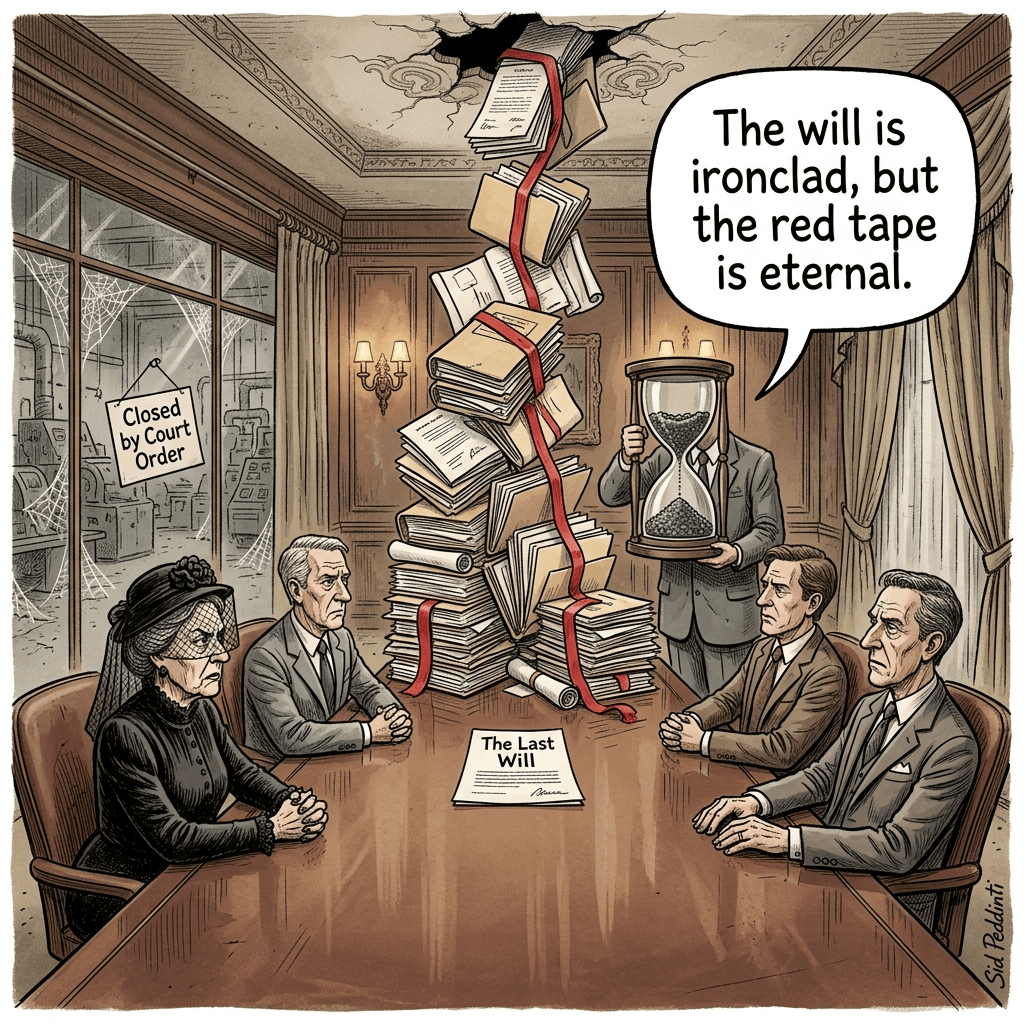
A Will is merely a letter to a judge. It has no legal power until a court “probates” it and officially appoints an executor or personal representative. This process can take weeks, months, or even years. During that gap, your business exists in a legal vacuum. No one can sign checks. No one can hire or fire. No one can fulfill contracts.
This is where UPC §3-307 (Informal Appointment) comes into play.
Understanding UPC §3-307: The Express Lane for Business Continuity
The Uniform Probate Code (UPC) was designed to make the transition of assets less of a bureaucratic nightmare. Section 3-307 is the “fast track.”
In states that have adopted the UPC, §3-307 allows for an “Informal Appointment.” This means your chosen representative can go to the court registrar, file a few documents, and receive their authority to act almost immediately – sometimes within days. They don’t have to wait for a formal court hearing in front of a judge.
Under UPC §3-307, once the registrar issues the “Letters,” your representative has the full power of the law to:
- Access business bank accounts.
- Negotiate with creditors.
- Maintain payroll.
- Keep the doors open.
Without this statute, or a plan that mimics its speed, your family is essentially trespassing on your own business property until a judge says otherwise.
The Great Divide: UPC States vs. Non-UPC States
The legal landscape of the United States is split. How your business survives depends largely on which side of the line you’re on.
The UPC States (The Smooth Path)
States like Colorado, Arizona, Florida (mostly), and Massachusetts have adopted versions of the UPC. In these jurisdictions, the process is streamlined. The law assumes that if things aren’t being contested, the court should stay out of the way. If your business is in a UPC state, your family can leverage §3-307 to keep the wheels turning with minimal friction.
The Non-UPC States (The Slog)
If you are in California, New York, Texas, or Illinois, you are in a “Non-UPC” state. In these jurisdictions, probate is often a formal, supervised, and notoriously slow process.
In a Non-UPC state, the court is the gatekeeper. Your family might have to wait for a scheduled hearing before a judge just to get the authority to pay the electricity bill for your office. We’ve seen businesses in these states lose their best talent and most loyal customers simply because the “authority gap” lasted longer than the business’s cash reserves.
What To Do If You Are Not in a UPC State
If you live in a state that doesn’t follow UPC §3-307, you cannot rely on the court system to be fast. You have to build your own “authority bridge.” Here is how you do it.
1. The Revocable Living Trust
This is the gold standard for business owners and non-profit founders. A Trust does not go through probate. When you place your business interests or organization control into a Trust, the “Successor Trustee” you named takes over immediately upon your death or incapacity. There is no judge, no waiting period, and no public record. It is a private, seamless handoff.
2. The “Springing” Power of Attorney
You need a durable power of attorney that specifically addresses business operations. However, be careful: most standard powers of attorney expire when you die. To bridge the gap before death (during incapacity) or to provide clear instructions for the transition, a robust, business-specific POA is vital. It’s too late once the person has lost their “capacity” or is “dead”, changes cannot be made.
3. Update Your Operating Agreement or Bylaws
If you run an LLC or a Non-Profit, your foundational documents should have a “Succession of Authority” clause. This clause should explicitly state who takes over management if the primary leader is gone. While a bank might still ask for court papers, having a clear corporate resolution in your bylaws gives your family a much stronger lever to pull when negotiating with financial institutions.
4. Buy-Sell Agreements with “Trigger” Clauses
For those with business partners, a Buy-Sell agreement is your insurance policy. It should include a provision that mandates how shares or management roles are transferred the moment a “triggering event” (like death) occurs. This prevents your partner from being stuck in business with your spouse, or your spouse from being locked out of the business you built together. We’ve seen this happen a lot – the business partner who built a business from the ground-up has to now deal with the deceased partner’s spouse, who wants to start calling the shots from day one, is not business savvy, or is just not easy to get along with. Many businesses end up collapsing due to these situations.
What Went Wrong: A Case Study in Neglect
We recently saw a for-profit in a Non-UPC state (California) nearly collapse. The founder was the only person on the bank account. When he passed, the board of directors realized they couldn’t access the funds to host their annual marketing conference – their biggest client-generator and fundraising event of the year.
Because they were in a Non-UPC state, they had to petition the court for an emergency “Special Administration.” It took more than three weeks and $7,000 in legal fees just to get a judge to sign a temporary order. By then, the venue had canceled their reservation due to non-payment. It was a disaster.
The client has a revocable trust in place. He had a power of attorney in place. He even had a business trust that he had set up to hold business assets and intellectual property.
The tragedy?
- They had never “formalized” the trust to be the member on the company
- They did not have a buy-sell agreement with “triggering causes”
- Teir operating agreement did not specifically cover these types of situations.
Practical Tips to Get It Right Today
You don’t need to be a lawyer to take the first steps. Use this checklist to ensure your organization doesn’t fall into the authority gap:
- Identify Your State Status: Look up if your state has adopted the Uniform Probate Code. If it hasn’t, move your “Succession Planning” to the top of your priority list.
- Audit Your Bank Accounts: Does your business account have a “Transfer on Death” (TOD) or “Payable on Death” (POD) designation? If not, ask your bank if this is an option for your entity type. A POD or TOD can avoid probate and does not require the bank account to be in a name of the trust.
- The 48-Hour Rule: Ask yourself: “If I disappeared tomorrow, who could sign a check in 48 hours?” If the answer is “no one,” you have a crisis on your hands.
- Consult a Strategist: Don’t just get a “fill-in-then-blank” Will or Trust from the internet. Talk to someone who understands the intersection of business law and probate.
The Bottom Line
UPC §3-307 is a powerful tool for those who have it, but it is not a replacement for a proactive strategy. Whether you are in a UPC state or not, the goal is the same: Zero Downtime.
Your family, your employees, and your community are counting on your business to survive your absence. Don’t let a procedural technicality be the reason your legacy ends. Build the bridge now, so they don’t have to scramble through the wreckage later.
If you have questions or concerns about your current documents, we now offer a complimentary, no-strings-attached, pro bono consultation where we focus on leveraging a series of sophisticated AI tools that help with:
- Identifying existing documents, terms, and clauses that are mismatched
- Spotting gaps, traps, or missing terms that can cause issues
- Aligning different documents together (especially business and estate)
- Evaluating the worst-case situations and reverse engineering a solution
Disclaimer: This is not a legal, tax, or finance call. No formal legal, tax, or financial advisory, fiduciary, or attorney-client relationship is formed by reaching out to us to receive a complimentary AI-Powered Consultation.
Thanks for reading, I’ve love to know your thoughts on this – did you know about these rules? Did you plan for these situations? Did you business or estate lawyers cover these nuances with you?
Thanks,
Sid Peddinti, Esq.
Tax Lawyer, AI Family Office Architect, and Publisher


 Law and Tax Magazine
Leave a comment