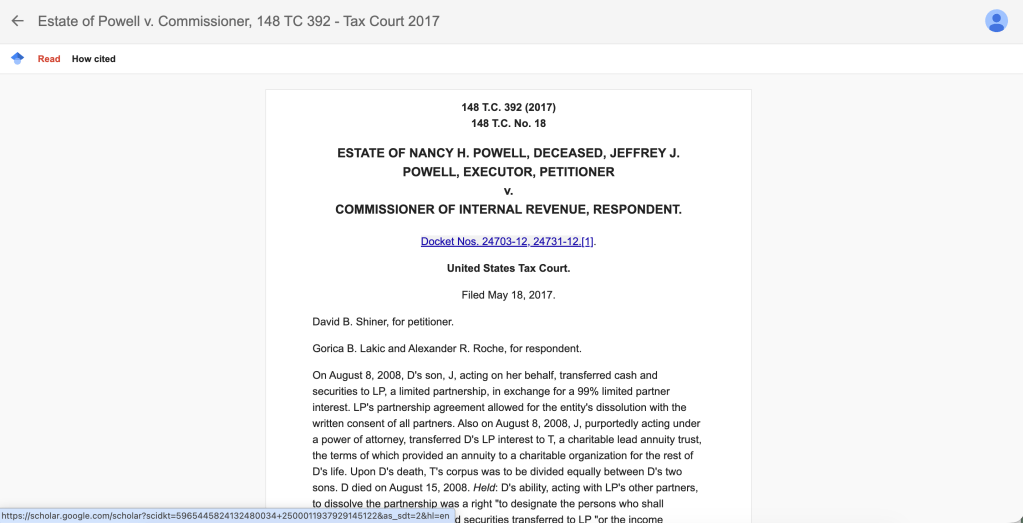
When Execution Collides with Estate Planning Law: Lessons from Estate of Powell v. Commissioner
By: Tax & Estate Planning Insights Editorial Team
Category: Estate Planning | Wealth Management | Legal & Tax Analysis
When high-net-worth clients engage in estate planning, the focus often centers on strategy: choosing the right entity structure, calculating valuation discounts, and optimizing wealth transfer efficiency.
However, as the U.S. Tax Court demonstrated in Estate of Powell v. Commissioner, even the most sophisticated strategy collapses when there is a disconnect between legal authority, statutory mechanics, and operational execution.
For estate planners, wealth advisors, tax professionals, and family offices, Estate of Powell serves as a warning against siloed planning—and a case study in why modern professionals must embrace comprehensive coordination, rigorous statutory analysis, and advanced audit tools to protect client wealth.
The Case Context: A Deathbed Planning Rush
In early August 2008, while Nancy Powell was hospitalized and incapacitated, her son Jeffrey—acting as her power of attorney (POA)—executed a series of rapid transactions:
- Entity Formation & Transfer: On August 8, Jeffrey transferred ~$10 million in cash and securities from his mother’s revocable trust into a newly formed Delaware limited partnership (NHP Enterprises LP) in exchange for a 99% limited partner (LP) interest.
- Subsequent Gift: On the same day, acting under the POA, Jeffrey attempted to transfer the 99% LP interest to a Charitable Lead Annuity Trust (CLAT).
- The Event: Nancy Powell passed away seven days later, on August 15, 2008.
The IRS issued deficiency notices for both estate tax and gift tax, setting off a major Tax Court review of Family Limited Partnerships (FLPs), retained control, and agent authority.
Core Legal Holdings & Tax Mechanics
The Tax Court’s ruling highlighted critical vulnerabilities that often go unnoticed in routine plan reviews:
1. Retained Control under I.R.C. § 2036(a)(2) & § 2035(a)
The court held that because the partnership agreement permitted dissolution upon the unanimous written consent of all partners, the decedent retained the right—in conjunction with others—to designate who would enjoy or possess the partnership assets or income.
Furthermore, because the attempted transfer of the LP interest to the CLAT occurred within three years of death, I.R.C. § 2035(a) required the underlying assets to be included in the gross estate regardless of whether the transfer was completed before her passing.
2. The “Doughnut & Doughnut Hole” Framework (I.R.C. § 2043(a))
Addressing concerns over potential double taxation, the Tax Court clarified how I.R.C. § 2043(a) applies when I.R.C. § 2036 pulls transferred assets back into an estate:
- The “Doughnut Hole” (Valuation Discount): Under § 2043(a), the amount included under § 2036(a)(2) is limited to the excess of the date-of-death value of the transferred assets over the consideration received (the LP interest). In effect, § 2036 pulls back the valuation discount taken.
- The “Doughnut” (LP Interest Value): The value of the LP interest itself remains subject to estate tax inclusion under § 2033 or § 2038(a).
3. Authority Deficits under State Power of Attorney Law
A key point of failure in the transaction stemmed from state law governing fiduciary authority. Under California Probate Code, an agent operating under a POA cannot make gifts unless explicitly granted that power in the instrument.
Because Nancy Powell’s POA only permitted gifts up to the federal annual exclusion limit, Jeffrey’s attempt to gift her entire 99% LP interest was void or revocable. As a result, full ownership of the LP interest remained part of her gross estate at death, while the gift tax deficiency was set aside because the transfer was legally incomplete.
Strategic Takeaways for Tax & Legal Professionals
The decision in Estate of Powell v. Commissioner offers vital operational lessons for wealth management practitioners:
- Partnership Drafting Matters: Standard boilerplate provisions allowing entity dissolution upon unanimous agreement of partners can inadvertently trigger I.R.C. § 2036(a)(2) inclusion if not carefully structured around fiduciary constraints.
- POAs Require Granular Precision: General grants to “manage or convey property” do not imply gifting authority. Powers of attorney must explicitly authorize high-value structural transfers if such maneuvers are intended.
- Avoid Siloed Execution: A gap between corporate formation, estate administration, and fiduciary law can undermine an entire wealth transfer strategy.
Modernizing Practice: Bridging Gaps with AI & Cross-Disciplinary Coordination
The primary lesson of cases like Powell is that blind spots exist where disciplines intersect. A financial advisor might set up an entity, a estate attorney might draft a trust, and an accountant might file the gift return—yet none may spot that the power of attorney lacks specific language authorizing an equity transfer.
Uncovering Hidden Structural Gaps
Wealth structures frequently suffer from hidden operational friction:
- Outdated POAs that fail to reflect current state statutes or client net worth.
- Entity dissolution clauses that clash with tax-retention rules.
- Unsynchronized asset titling between trusts and underlying operating agreements.
Leveraging Next-Generation AI Analysis Tools
To safeguard clients against these overlooked liabilities, modern practices must go beyond traditional manual audits. Today’s artificial intelligence tools allow legal and tax advisors to run comprehensive, cross-document analyses across complex portfolios:
- Document-to-Statute Verification: Advanced AI legal engines can cross-examine estate planning instruments against specific state probate codes to instantly flag authority deficits in POAs or trust agreements.
- Conflict & Language Auditing: AI synthesis tools can compare partnership agreements, operating agreements, and trust provisions simultaneously to identify conflicting dissolution language or retained control triggers.
- Continuous Plan Auditing: Rather than relying on sporadic manual reviews, multi-modal AI platforms allow advisors to continuously audit client files as tax laws, court precedents, and family dynamics evolve.
By pairing deep legal expertise with automated analytical workflows, advisory teams can identify and resolve hidden gaps before they become multi-million-dollar tax court disputes.
Primary Sources & Further Reading
- Estate of Powell v. Commissioner, 148 T.C. 392 (2017) – Google Scholar Official Opinion Text
- Internal Revenue Code § 2036 (Transfers with Retained Life Estate)
- Internal Revenue Code § 2035 (Adjustments for Certain Gifts Made Within 3 Years of Death)
- Internal Revenue Code § 2043 (Transfers for Insufficient Consideration)
Disclaimers
Legal & Tax Advice Disclaimer:
This article is published strictly for educational, informational, and professional discussion purposes and does not constitute legal, tax, accounting, or financial advice. The strategies and legal interpretations discussed herein may not be suitable for every situation or jurisdiction. Readers should consult with qualified legal counsel and certified tax professionals before implementing any estate planning, tax strategy, or structural changes.
AI-Generated Content Disclaimer: Portions of this article and its underlying analytical summaries were compiled, structured, and formatted using artificial intelligence technologies. While the editorial team has reviewed and curated the content for technical accuracy against primary legal sources, automated tools may generate inaccuracies or incomplete interpretations. Independent verification of all legal authority, statutes, and citations is strongly recommended.
Share this story on your social media and boost your profile, visibility, and empower your connections. One shared post can protect a friend or client’s wealth by upwards of 10-30% in many cases.
 Law and Tax Magazine
Leave a comment