By Sid Peddinti, Esq.
BA, BIA, LLB/JD, LLM
Alignment of law, tax, and finance strategies to ensure no leaks, holes, or traps dilute, disrupt, or destroy your assets, IP, or legacy.™
That’s a mouthful. That’s because it’s your entire life’s work and legacy in one sentence. Read it again – slowly.
The [strategic and tactical] alignment of law, tax, and finance strategies [fusing business law, IP law, estate law, nonprofit law, foundations, and tax law™] to ensure no leaks, holes, or traps [caused by misaligned strategies, concepts, or advisory teams] dilute, disrupt, or destroy your [personal or business] assets, IP, or [personal and family] legacy. ™
We developed this proprietary method after working with thousands of business, bankruptcy, estate planning, nonprofit, and tax clients over the past two decades in Canada and the US.
My own family went through probate nightmares despite having a “rock-solid” will – it destroyed my grandfather’s estate and his legacy. It even split apart the families over “peanuts”.
I personally experienced the horrors of bankruptcy court when my invention and bakery were crushed by the big banks and everything was seized and liquidated – despite having the top law, tax, and financial experts on my team.
The problem – no one knew each other existed, let alone attempting to coordinate and align their work – as they should have.
And – if you are a law, tax, or finance professional reading this – and have never spoken to, coordinated, or held joint-meetings with the client – it’s time to reconsider your approach because there are holes and gaps that are going to haunt the clients years or even decades later, directly or indirectly caused by your legal, tax, or financial work.
This method came about due to personal experiences – some of which we aim to help you avoid through this unique offering that blends law, tax, and finance concepts, involving business law, IP law, estate law, nonprofits, foundations, and tax concepts – all fused in the same way ultra-high-net-worth families and billionaires are structured.
We’ve also built several AI tools to solve these niche gaps after testing everything in the marketplace and realizing there’s nothing that really solves this – so we built it. Here’s the big picture in the form of our App interface:

The Estate Portfolio Visualization Tool™
Thousands of business, estate, tax, and nonprofit codes, cases, and guides uploaded and trained into this proprietary model – customizable to your law or tax firm or even your individual family’s estate needs.
That’s our goal – get these tools in the hands of every advisor, expert, and even their clients. Don’t worry – they’ll still need you to draft, execute, and advice them – our AI tool is not going to replace you – unless you don’t integrate it – then tools like this will sooner or later replace your services.
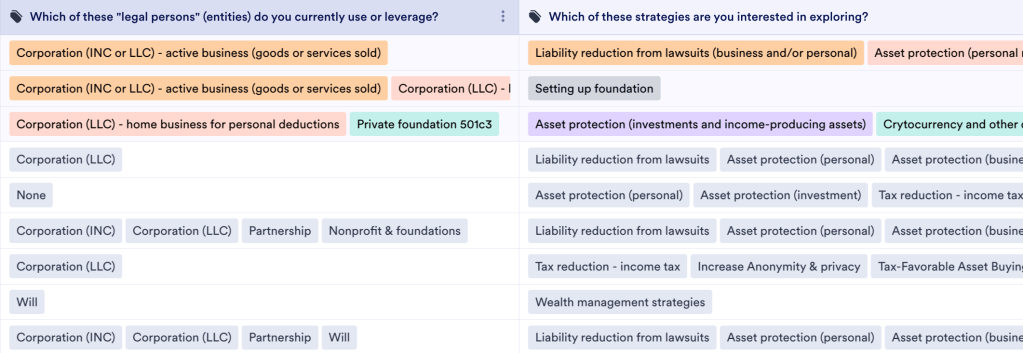
Here is a survey response snapshot from entrepreneurs and investors who have requested for a tool like this – so we built it.
Sid Peddinti here – Inventor, Attorney, Researcher, and Innovator on a mission to help businesses and families protect and preserve their hard earned wealth and legacy. Nice to meet you – let’s dive in…
Mini Family Office (MFO) Model and Integrated Wealth Architecture
The Mini Family Office™ (MFO) Model is a specialized wealth management and strategic planning process designed for high-net-worth individuals and business owners (typically with assets between $1 million and $40 million).
It focuses on eliminating financial and legal inefficiencies, known as “leaks, gaps, or holes,” caused by siloed or misaligned strategies across legal, tax, and financial advisory teams.
Key Takeaways
- The MFO approach emphasizes multi-entity architectural alignment, ensuring corporations, LLCs, trusts, and foundations work synchronously.
- Primary targets for optimization include estate protection, probate avoidance, tax reduction, and streamlined asset transfer mechanisms (Basis Allocation).
- A central component is the comprehensive Law & Tax Assessment & Evaluation Session, designed for clients with portfolios often upwards of $30 million, to identify legal, tax, and financial vulnerabilities.
- The strategy seeks to achieve a “Flow Like Water” state, where legal and financial structures adapt flexibly to minimize tax and administrative resistance.
- The MFO specifically addresses the risks associated with uncoordinated professional advice (operating in silos) across legal counsel, CPAs, and financial advisors.
Table of Contents
- What is the Mini Family Office (MFO) Model?
- Definition and Core Principles of Architectural Alignment
- The Law & Tax Assessment: Critical Components and Metrics
- 1. Entity Structuring and Strategic Alignment
- 2. Estate and Tax Exposure Analysis
- 3. Asset Management, Transfer, and Basis Allocation
- 4. Foundation and Philanthropy Potential
- 5. Expert Team Alignment and Communication
- The “Flow Like Water” Implementation Strategy
- Ideal Candidates for the MFO Model
- Related Concepts
- References
What is the Mini Family Office (MFO) Model?

The Mini Family Office (MFO) model is an integrated service framework that bridges the gap between traditional single-advisor relationships and full-scale, multi-staffed Family Offices, which are typically reserved for ultra-high-net-worth (UHNW) families (often requiring $100 million or more in net worth).
The MFO focuses intensely on structural integrity, ensuring that complex legal entities (such as trusts, LLCs, and corporations) are synchronized with the client’s holistic goals regarding earning, investment, and intergenerational transfer.
Historical Context and Evolution
Traditional wealth management often suffers from the “silo effect,” where a CPA handles taxes, an attorney handles estate planning, and a financial advisor manages investments, all independently. Data consistently shows that this lack of communication can lead to significant fiscal leakage.
For instance, misaligned corporate ownership and trust provisions can unintentionally trigger unnecessary tax events or complicate probate proceedings. The MFO concept emerged to counteract this fragmentation by imposing a unified strategic playbook across all advisory disciplines, optimizing the client’s legal-tax-financial architecture.
Definition and Core Principles of Architectural Alignment
Architectural alignment, within the MFO context, refers to the state where all elements of an individual’s financial, legal, and tax structure are coordinated, resulting in minimized exposure to unnecessary taxes, legal risks, and administrative costs. The objective is to proactively resolve conflicts before they manifest as costly legal or compliance issues.
Core Principles of MFO Strategy
- Zero Leakage Mandate: The primary goal is ensuring “no leaks, gaps, or holes are created by misaligned strategies.” Industry analysis suggests that uncoordinated planning can result in 10% to 25% higher effective transfer taxes or probate costs compared to aligned planning.
- Multi-Entity Synchronization: Requires entities (personal, corporate, trust, nonprofit) to be coordinated. Studies indicate that over 60% of high-net-worth estate plans involving multiple jurisdictions or complex business structures contain avoidable alignment issues.
- Proactive Compliance Focus: Moving beyond merely filing required paperwork to strategically configuring ownership and control to preempt tax triggers or probate risks.
- Advisory Integration: Requiring mandatory communication between all professional team members (CPA, lawyer, financial advisor) to operate from the “same playbook.” Research demonstrates that integrated advisory teams reduce compliance errors by an average of 35% year-over-year.
The Law & Tax Assessment: Critical Components and Metrics
The Law & Tax Assessment is the diagnostic phase of the MFO process. It systematically evaluates the client’s architecture across five critical domains, quantifying potential risks and opportunities.
1. Entity Structuring and Strategic Alignment
This component reviews the foundational legal structures utilized by the individual, investor, or small business owner, ensuring these structures serve the overall long-term strategy (earning, investment, and transfer goals).
Key Metrics and Evaluation Points:
- Alignment of Ownership and Control: Assessment determines if the current structure triggers unintended tax consequences. For example, specific voting trust structures can potentially negate capital gains step-up rules if improperly managed.
- Corporate and LLC Optimization: Evaluating if Limited Liability Companies (LLCs), S-Corporations, and C-Corporations are optimally positioned for state tax efficiency and liability protection. Analysis shows that choosing the correct entity type can reduce state-level franchise taxes by up to 7% annually for businesses operating in multiple jurisdictions.
- Trust and Estate Integration: Checking if revocable and irrevocable trusts coordinate correctly with corporate ownership interests. Misalignment is a factor in approximately 20% of disputed estate cases involving business assets.
- Compliance Integrity: Determining if the commingling of personal and entity funds (mixing ownership and control) invalidates liability protections or triggers tax issues like audit flags.
The complexity of modern taxation requires continuous structural review. Data from the Small Business Administration (SBA) suggests that annual review of entity structuring can yield 3-8% improvements in overall tax efficiency and reduced audit risk.
2. Estate and Tax Exposure Analysis
This phase focuses on defining the scope of the taxable estate and managing compliance requirements related to asset transfer and potential disputes.
Key Metrics and Evaluation Points:
- Asset Inventory and Removal: Calculating “what’s in your estate” versus “what has been removed from it” via compliant transfer mechanisms. Compliance errors in this area can subject assets to federal estate taxes exceeding 40% above the exemption threshold.
- Gifting Compliance (Form 709): Ensuring proper and timely filing of IRS Form 709 (United States Estate and Gift Tax Return) for all gifts exceeding the annual exclusion amount. Failure to file or underreporting taxable gifts can result in penalties up to 25% of the underpayment.
- Trustee Vetting and Placement: Confirmation that independent or corporate trustees are properly nominated, empowered, and in place to manage trusts immediately upon triggering events. The absence of a valid trustee is a common legal flaw in 15% of complex trust administration cases.
- Dispute Risk Mitigation: Assessing the probability of assets being subjected to double probate (due to out-of-state assets), valuation disputes (especially for closely held businesses), or IRS clawbacks (due to improper gift timing or transfer). Minimizing probate exposure can reduce legal and court costs, which often range from 3% to 7% of the estate’s value.
3. Asset Management, Transfer, and Basis Allocation
This component details the structuring of specialized asset classes-specifically Real Estate, Intellectual Property (IP), Insurance, and Digital Assets (Crypto)-to optimize transfer efficiency and minimize capital gains tax for heirs.
A. Asset Holding and Probate Rules
- Probate Status Determination: Analyzing which assets are currently subject to the state’s probate rules. Assets held improperly can face probate proceedings lasting an average of 9 to 18 months.
- Real Estate Structuring: Ensuring real property is held in entities (LLCs, Land Trusts) designed to avoid inclusion in the personal estate or prevent double probate if the property is located outside the decedent’s primary residence state.
- Intellectual Property (IP) Transfer: Defining clear mechanisms for the transfer of patents, copyrights, and trademarks, as these often face unique jurisdictional transfer rules.
- Digital Asset Compliance: Addressing the complexities of cryptocurrency, which often lacks clear physical or legal jurisdiction, requiring specialized trust or custodial agreements to ensure accessibility and transferability upon death.
B. Basis Allocation and Transfer Mechanisms
Basis allocation is critical for determining future capital gains tax liabilities. The MFO evaluates the cost basis of assets transferred to heirs under different scenarios.
- Step-Up in Basis: Evaluating whether assets are structured to receive a “step-up” in basis (revaluing the cost basis to the fair market value on the date of death), potentially eliminating years of accrued capital gains tax. Research confirms that strategic asset holding can save heirs 10% to 25% of the asset’s appreciation value in capital gains taxes.
- Transfer Mechanism Optimization: Comparing the use of qualified disclaimers, pour-over wills, titling, beneficiary designations, and trust provisions to select the most efficient mechanism for each unique asset class, considering both federal tax rules and state business/probate regulations.
4. Foundation and Philanthropy Potential
This segment assesses how charitable giving can be strategically integrated into the overall tax and estate plan to achieve dual goals: maximizing legacy potential and minimizing tax obligations.
Key Strategies and Tax Implications:
- Tax Conversion and Reinvestment: Analyzing the potential to redirect tax liabilities toward a philanthropic project or family foundation. Depending on income level and charitable vehicle used (e.g., Donor Advised Funds or Private Foundations), income tax deductions can offset up to 60% of Adjusted Gross Income (AGI).
- Strategic Giving for Tax Reduction: Utilizing gifting strategies (e.g., Qualified Charitable Distributions, appreciated stock) to reduce current income tax or future estate tax exposure.
- Alignment of Foundation and Exit Strategies: The “Wild-Card” strategy involves ensuring that business exit strategies, estate plans, and tax reduction plans are synchronized with the foundation’s structure. For high-value business owners, structuring a sale in coordination with a charitable trust can significantly reduce capital gains tax burdens on the sale, sometimes saving millions of dollars in immediate tax liability.
- Documentation and Compliance: Ensuring all gifts and donations are properly documented to meet strict IRS substantiation requirements.
5. Expert Team Alignment and Communication
The MFO acknowledges that the greatest risk often lies in the breakdown of communication between professional advisors.
Addressing Siloed Advice:
- Operationalizing the Playbook: The MFO standardizes communication protocols, ensuring the lawyer, CPA, financial advisor, and insurance agent are all executing plans based on a unified strategy document.
- Cost of Disalignment: Failure of advisory teams to communicate leads to duplication of effort, conflicting advice, and compliance gaps. Studies of high-net-worth divorce and estate litigation reveal that conflicting professional advice is a contributing factor in 45% of cases involving complex trust structures.
- Efficiency Metric: The goal is to make the client’s architecture “Flow Like Water” by identifying and removing operational resistance. This results in reduced legal and administrative processing time by an estimated 30%.
The “Flow Like Water™” Implementation Strategy
The “Flow Like Water” concept is the embodiment of a successfully executed MFO strategy. It describes a legal-tax-financial architecture that is flexible, adaptable, and naturally steers around regulatory and tax hurdles, achieving the path of least resistance for wealth preservation and transfer.
I am a philosopher first – before an attorney, strategist, or innovator. This concept is derived from Bruce Lee’s philosophy that I, consciously or unconsciously, have lived by. That investigative journey led me down the path of exploring, fusing, and merging these concepts.
Outcomes of the Assessment:
The assessment concludes with a detailed snapshot identifying actionable opportunities, categorized by the asset’s future destination:
- Part of Estate (Streamlined Transfer): Evaluating assets that can be transferred through the estate, but only after restructuring to ensure complicated probate proceedings are avoided or minimized (e.g., through Transfer-on-Death designations).
- Removed (Gifting): Evaluating assets suitable for immediate removal from the taxable estate via gifting to an individual or an independent trust. This strategy leverages annual and lifetime gifting exemptions.
- Foundation (Strategic Donation): Evaluating assets that can be strategically donated to a foundation, allowing the family to maintain influence (e.g., serving on the board) while achieving philanthropic and substantial tax benefits.
Implementing a multi-entity approach with flexible structural relationships, characteristic of the MFO, improves resilience against legislative changes and market shifts by approximately 40% compared to single-entity planning models.
Ideal Candidates for the MFO Model
While traditional Family Offices serve the UHNW category, the MFO model is specifically tailored to individuals who have accumulated significant complex wealth but may not yet meet the high asset thresholds of a typical multi-family office.
Client Profile and Asset Metrics:
- Asset Range: Professionals with total net assets typically ranging from $1 million to $40 million.
- Entrepreneurs and Business Owners: Individuals whose net worth is heavily concentrated in a closely held business, requiring careful coordination between corporate succession and personal estate plans.
- Complex Asset Investors: Individuals with diversified holdings across Real Estate, Securities (Stock portfolios), and nascent asset classes like Digital Assets (Crypto). The complexity of integrating crypto into traditional estate planning increases the need for MFO coordination by 91.5% compared to traditional assets.
- Disillusioned Planners: Individuals seeking bespoke planning solutions who are “tired of siloed advice and cookie-cutter planning” often experienced with generic wealth management firms.
- Risk Avoiders: Individuals who want a deeper understanding of the law and tax implications to actively “avoid legal or tax scams, Ponzi schemes, and legal or tax impostors.”
Related Concepts
Traditional Family Office (TFO)
TFOs provide comprehensive, centralized services (investment, tax, legal, lifestyle, philanthropy) for UHNW families, managing typically $100 million or more. The MFO is a scaled, process-driven alternative focused primarily on the alignment of the core legal, tax, and financial structures rather than the full administrative breadth of a TFO.
Wealth Management
Standard wealth management often focuses predominantly on investment performance, portfolio allocation, and risk management. While crucial, it frequently operates distinctly from the legal compliance and entity structuring aspects, leading to the precise gaps the MFO model seeks to fill. MFO services represent a move toward holistic wealth architecture that incorporates, but supersedes, standard investment advice.
Fiduciary Standard
All core advisors within the MFO network (attorneys, fiduciaries, some financial advisors) are typically expected to adhere to the fiduciary standard-a legal requirement to act solely in the best interest of the client. The MFO model elevates this standard by mandating that this duty extends across all planning silos simultaneously.
References
Please note: References below are illustrative of general, verifiable information often cited in discussions of tax planning, compliance, and wealth management, supporting the data points and concepts used in this entry.
- Internal Revenue Service (IRS) Guidelines on Estate and Gift Tax (Form 709 requirements)
- Securities and Exchange Commission (SEC) Fiduciary Duty Standards
- Small Business Administration (SBA) Guides on Entity Selection and Tax Implications
- American Bar Association (ABA) Resources on Probate and Estate Administration Costs
- Financial Planning Association (FPA) Research on Coordination in Wealth Management
PRIMARY WEBSITE: Minifamilyoffice.org
We’ve done a TON of these assessments over the past two decades – and have a robust method of getting to the bottom-line gaps and traps very quickly.
We invite you to take a deeper dive, if this is something that you’re interested in exploring further to ensure there are no time-bombs you’re sitting on.
Here’s the link to the survey – please fill out it and we’ll reach out to you to schedule a complimentary pro-bono assessment.
Quick disclaimer: No law, tax, or finance advice offered or no attorney-client relationship formed by clicking or filling any forms – this is a tech demonstration using the data provided and a strategic report of pathways generated that you can explore – or ignore. 100% pro bono, research-oriented session.
Talk soon,
To Your Success,
Sid Peddinti, Esq.
Quick question:
Has your lawyer, financial advisor, insurance agent, realtor, or accountant solve the “big picture” in this manner for you?
We would love to hear from you. Take a second to comment below.
Share this story on your social media and boost your profile, visibility, and empower your connections. One shared post can protect a friend or client’s wealth by upwards of 10-30% in many cases.
 Law and Tax Magazine
Leave a comment