Dear Friend,
Today, I want to cover a topic that has caused, and still causes a LOT of confusion and misinterpretation in the marketplace – the key definition of a GRANTOR.
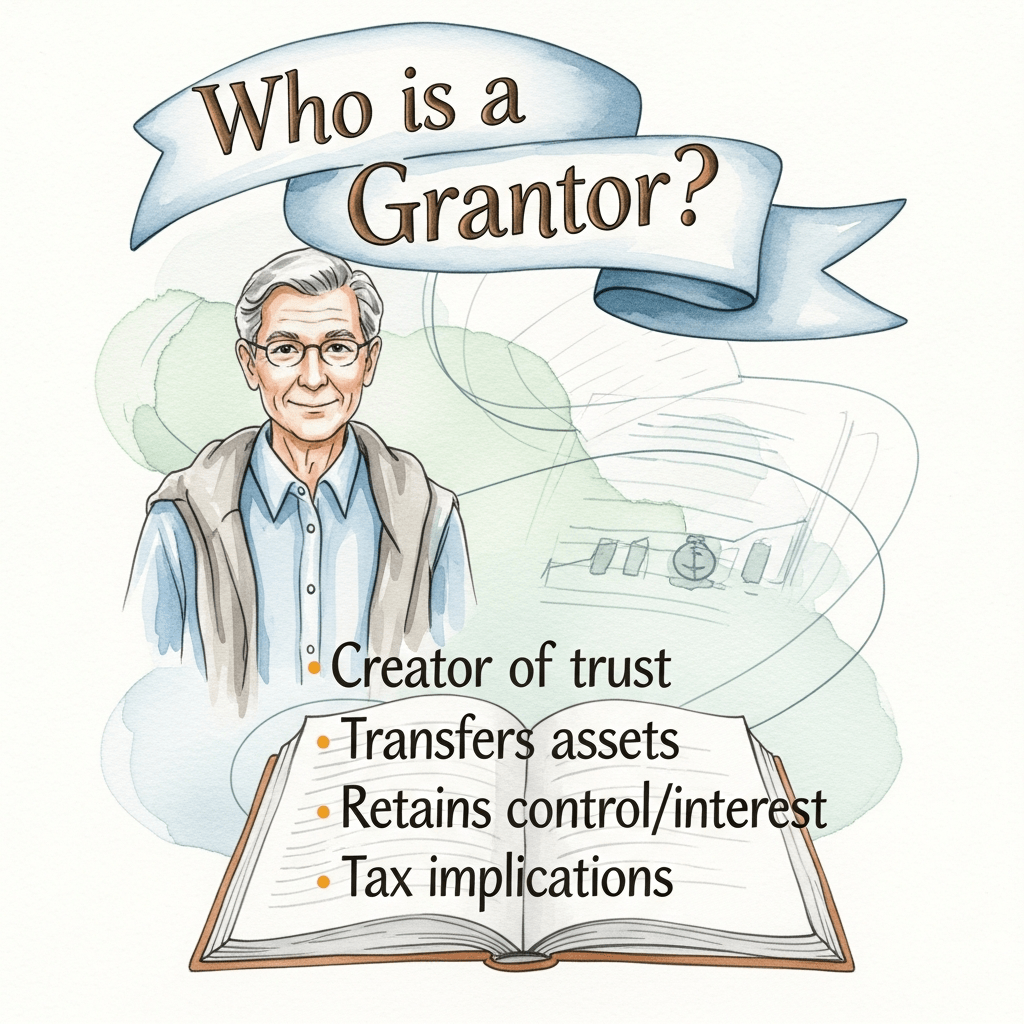
A grantor is simply the original creator of a trust, also known as the trustor or settlor. This person is the one sets up, funds, and transfers their assets into the trust’s legal ownership structure. This is a very basic definition and is very broad. For tax purposes, the term “grantor” takes on a far more complex and costly meaning.
The key distinction is whether the trust is deemed a “Grantor Trust” or a “Non-Grantor Trust.” This classification determines who pays the taxes: the grantor or the trust itself/beneficiaries.
Let’s break down the two major tax categories where the grantor definition is everything.
Part 1: The Grantor for Income Tax Purposes 💰
For income tax, a trust is a Grantor Trust if the grantor retains certain powers or interests over the assets. These rules are strictly defined by Internal Revenue Code Sections 671 through 679. If these rules are triggered, the trust is considered a “disregarded entity” for income tax.
This means the trust itself does not pay the income tax; it reports to the grantor. The grantor must report all the trust’s income, deductions, and credits on their personal tax return, Form 1040. Essentially, the IRS treats the assets as if they were still owned personally by the grantor, even though legally they are held in the trust.
There are two distinct concepts involved here – the legal concepts and the tax concepts – both are independent and interconnected at the same time. Separation of “legal title” (transferring ownership of an asset from your name to a trust name) does not automatically determine the income tax obligations.
You have to look at the terms, the relationship of the parties, the “intention” behind structuring and transferring assets into the trust name, and the “level of control” over “assets and income” – that’s what determines income tax obligations. Here are 4 common “triggers” that can cause the income tax obligations to be the grantor’s responsibility:
- One trigger is a retained power to revoke the trust, which is common in a standard revocable living trust.
- Another trigger is a retained power to control the beneficial enjoyment of the trust principal or income.
- The power to reacquire the trust property by substituting other property of equivalent value can also trigger grantor trust status.
- If the income is or may be distributed to the grantor or their spouse, this status is also likely activated.
It’s important to note that “income tax” is a completely different and separate concept from “gift and estate tax”.
When you enter into the world of advanced estate planning, you start leveraging options like the Intentionally Defective Grantor Trust (IDGT) – which uses these rules more strategically.
An IDGT is purposefully designed to be a Grantor Trust for income tax but not for estate tax. This allows the grantor to pay the income tax on behalf of the trust, letting the trust assets grow tax-free for the beneficiaries.
Trust tax rates for “non-grantor trusts” are much higher than individuals face – so in certain situations, a trust may be structured so the “assets” are dissected further – the grantor pays the income tax portion, but relinquishes control of the assets in a manner that still qualifies it as a “completed gift” – which removes the asset from their estate for estate and gift tax purposes.
The result: Your beneficiaries can receive highly appreciated assets without “state probate, state inheritance tax, and federal estate tax” imposed on the transfer. Whereas, in a more straightforward grantor trust, assets may be subject to state inheritance and federal estate taxes before beneficiaries receive the assets.
THE BOTTOM LINE:
There is no “one-size-fits-all” structure out there.
That is a 100% false myth that can completely destroy, dilute, and demolish your estate. You have to carefully consider multiple tax and estate scenarios and calculations before deciding which option suits your unique needs.
In some situations, it makes sense to pay the income tax and retain ownership (even if you are subject to gift/estate taxes), whereas in some situations paying income tax, but bypassing estate taxes makes more sense. Let’s now examine the “grantor” for estate tax liability.
Part 2: The Grantor for Estate Tax Purposes ⚰️
For estate tax, the definition of a grantor relates to whether the trust’s assets will be included in their taxable estate upon death. Inclusion for estate tax is governed primarily by Internal Revenue Code Sections 2036, 2037, and 2038.
If the assets are included in the grantor’s gross estate, they may be subject to federal estate tax, which can be up to 40%. The core concept is whether the grantor has retained an “economic interest” or “control” over the transferred property.
- Section 2036 covers retained life estates and retained powers to designate who possesses or enjoys the property. If you transfer your house to an irrevocable trust but keep the right to live there rent-free, the entire value of the house is included in your estate.
- Section 2038 addresses the power to alter, amend, revoke, or terminate the enjoyment of the trust.
- A common estate planning tool is a Grantor Retained Annuity Trust (GRAT).
- In a GRAT, the grantor transfers assets to the trust but retains the right to receive an annuity payment for a fixed term. The goal of a GRAT is for the appreciated value of the assets to pass to heirs with minimal or zero gift tax value.
- However, there is a risk – if the grantor dies before the annuity term ends, a portion of the trust assets is pulled back into their taxable estate under Section 2036.
- Another tool, the Qualified Personal Residence Trust (QPRT), is where the grantor transfers their home but retains the right to live in it for a term of years.
The grantor for estate tax purposes is the person who hasn’t fully and finally relinquished all strings of ownership and control.
Summary: The Power of the Grantor Definition
The grantor is not just the person who started the trust; they are the tax linchpin.
For income tax, a Grantor Trust means the creator pays the taxes while the trust funds grow.
For estate tax, a grantor who retains too much control means the assets are still “theirs” for the 40% death tax.
This dual-track system requires meticulous planning to ensure the grantor is treated as the owner for one purpose but not the other.
Navigating this complex intersection of trust law and tax code is what separates good estate planning from great wealth preservation.
These advanced planning tools are highly complex and needs total alignment between law, tax, and financial experts – or you can end up facing layers of unnecessary taxes and transfer costs.
Always consider multiple scenarios before deciding one particular type of “trust” is the holy grail that will preserve your family’s wealth, because the truth is that there is no “one-size-fits-all” strategy.
Life happens – family dynamics change, relationships change, goals change. Taking a flexible and multi-entity approach allows you to pivot as needed, so you can maximize your wealth according to your wishes.
Have thoughts, questions, comments?
Enter it below, I’d love to read them and/or offer research, or answers.
Thanks for reading.
Sid Peddinti, Esq.
Here are some resources worth reading:
- A Comprehensive List of cases and codes: https://research.nonprofitx.org/trustresearch
- Section of the code §671-679: https://www.law.cornell.edu/uscode/text/26/subtitle-A/chapter-1/subchapter-J/part-I/subpart-E
- Definition of a grantor (IRS Publication): https://www.irs.gov/pub/irs-regs/td8890.pdf
- Internal Revenue Service. “Abusive Trust Tax Evasion Schemes – Questions and Answers.”
- Internal Revenue Service. “5.5.7 Collection Estate and Gift Tax Accounts.” Section 5.5.7.32(09-16-2013)
- Internal Revenue Service. “2021 Instructions for Form 1041 and Schedules A, B, G, J, and K-1.” Page 18.
- Internal Revenue Service. “LB&I International Practice Service Process Unit – Audit.” Page 20.
- Internal Revenue Service. “Number 201919003.” Page 2.
- Tax Policy Center. “Briefing Book/What Is a Tax Shelter?“
- Vail Gardner Law. “Learn Trust Basics: Who Is the Grantor vs. Trustee?”
#GrantorTrust #EstatePlanning #TaxLaw #TrustsAndEstates #IRS



 Law and Tax magazine
Leave a comment