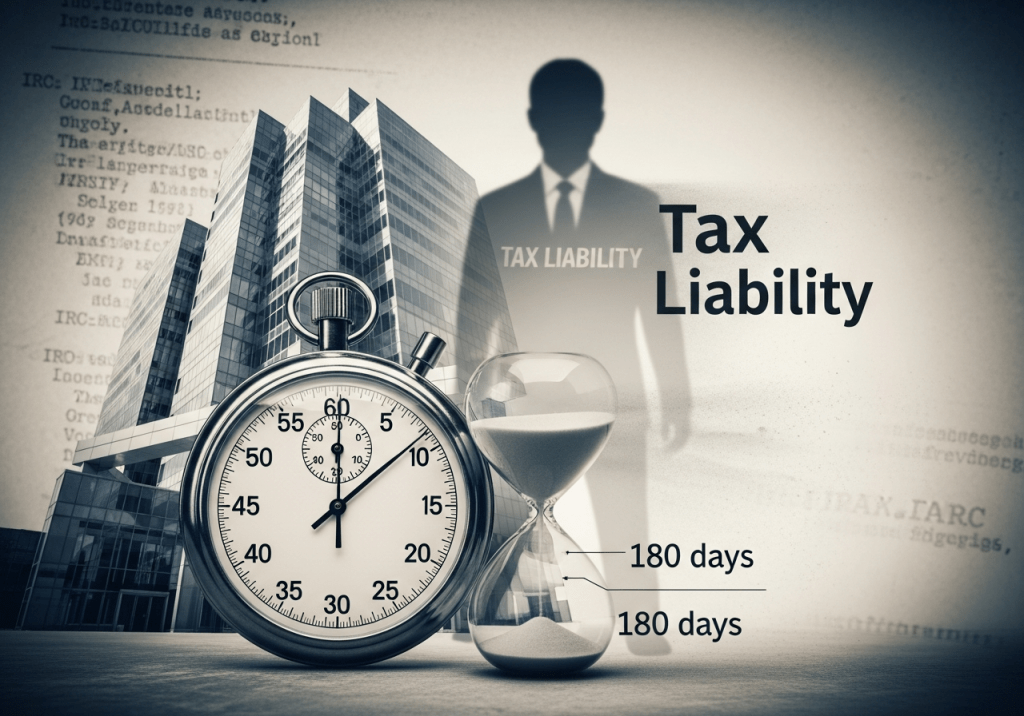
The 1031 Exchange: A Comprehensive Guide to Tax-Deferred Real Estate Investment
By: Sid Peddinti | November 2025
Summary:
Selling highly appreciated investment property triggers massive capital gains tax? Use a 1031 Exchange to defer 100% of the liability indefinitely.
REAL-USE CASE: An investor sells a rental building for $1.5 million and immediately buys a shopping center, deferring approximately $300,000 in combined federal and state capital gains and depreciation recapture taxes.
STEPS:
1. The sale proceeds must be held by a third-party Qualified Intermediary (QI) to prevent constructive receipt.
2. The investor must identify the replacement property as ‘like-kind’ to the relinquished property.
3. A strict 45-day clock begins upon the sale of the relinquished property to identify potential replacements.
4. A strict 180-day clock is imposed to close on the identified replacement property.
5. To achieve full tax deferral, the value of the replacement property must be equal to or greater than the net selling price of the relinquished property.
DEEP DIVE
The 1031 Exchange, formally codified under Section 1031 of the Internal Revenue Code (IRC), is a powerful but complex mechanism utilized by investors to defer capital gains tax when selling investment property and reinvesting the proceeds into similar, or ‘like-kind,’ property. It is often referred to as a ‘like-kind exchange.’
This strategy does not eliminate tax liability; rather, it postpones the payment until the replacement property is eventually sold without another exchange, or until the investor’s death.
The Core Principles and Mechanics
The fundamental requirement of a 1031 Exchange is that the properties involved must be ‘held for investment’ or ‘used for productive use in a trade or business.’ Crucially, personal residences and properties bought purely for resale (inventory) do not qualify. The definition of ‘like-kind’ applies to the nature of the property, not its type; for instance, raw land held for investment can be exchanged for a commercial office building, as both are considered real property investments.
To successfully execute a 1031 Exchange, the investor must avoid ‘constructive receipt’ of the sale proceeds. This necessitates the involvement of a Qualified Intermediary (QI), a third party who holds the funds generated from the sale of the relinquished property until they are used to acquire the replacement property. Direct receipt of funds by the taxpayer voids the exchange and triggers immediate taxation.
Strict Timing Requirements
The most challenging aspects of the 1031 Exchange involve its stringent timing requirements, which are set in calendar days, not business days:
- The 45-Day Identification Period: Starting from the date the relinquished property is transferred, the investor has 45 calendar days to formally identify potential replacement properties. This identification must be unambiguous and in writing, typically delivered to the QI. Identification rules are precise: an investor can identify up to three properties of any value (the Three Property Rule), or any number of properties provided their combined fair market value does not exceed 200% of the value of the relinquished property (the 200% Rule).
- The 180-Day Exchange Period: The investor has 180 calendar days from the sale of the relinquished property (or the due date of the tax return for the year of transfer, whichever is earlier) to complete the purchase and close on one or more of the identified replacement properties. There are no extensions for these deadlines, except in declared national disasters.
Tax Implications and Basis Carryover
The primary tax advantage of a 1031 Exchange is the complete deferral of both federal capital gains tax and depreciation recapture. Depreciation recapture is taxed at a maximum federal rate of 25%, while long-term capital gains are taxed at 0%, 15%, or 20%, depending on the investor’s income bracket. By deferring these liabilities, the investor retains 100% of the equity to reinvest, significantly enhancing compounding growth over time.
However, the tax liability is not eliminated; it is carried forward. The tax basis of the relinquished property is transferred to the replacement property. For example, if an investor sells a property with a $100,000 basis and a $500,000 sales price, the deferred gain is $400,000. If the replacement property costs $600,000, the new tax basis becomes $200,000 ($600,000 cost minus the $400,000 deferred gain). This lower basis means that if the replacement property is later sold in a taxable transaction, the accumulated gain will be substantially higher.
An important potential benefit occurs if the investor holds the replacement property until death. Under current law, the property receives a ‘step-up in basis’ to its fair market value on the date of death. This eliminates all the deferred capital gains and depreciation recapture accumulated over decades, providing a massive tax advantage to the heirs.
Dealing with Boot and Partial Exchanges
If the investor receives cash or non-like-kind property during the exchange process, this is considered ‘boot’ and is taxable up to the amount of the recognized gain. Boot can arise in two common forms: cash boot (such as leftover funds after closing) or mortgage boot (when the debt assumed on the replacement property is less than the debt relieved on the relinquished property). To achieve full deferral, investors must ensure that the net purchase price of the replacement property is equal to or greater than the net sales price of the relinquished property, and that the debt on the replacement property is equal to or greater than the debt on the relinquished property.
Historical Context and Modern Restrictions
The 1031 Exchange has been a cornerstone of real estate investment strategy for decades. Historically, prior to the Tax Cuts and Jobs Act (TCJA) of 2017, the rules permitted the exchange of many types of property beyond real estate, including heavy equipment, fine art, and even some intangible assets. However, the TCJA, effective January 1, 2018, severely restricted the definition of ‘like-kind property’ to explicitly include only real property. This legislative change eliminated the possibility of exchanging personal property items, such as fleets of vehicles or specialized machinery, for tax deferral purposes under Section 1031, focusing the provision solely on real estate investment.
Understanding the precise requirements, especially the non-negotiable deadlines and the implications of receiving boot, is crucial for any investor considering this strategy. Due to the high financial stakes and complexity, professional guidance from a Qualified Intermediary and a tax advisor is mandatory.
Disclaimer: This material is for educational purposes only and does not constitute legal, tax, or financial advice.
Share this article with your family, friends, customers, followers, and loved ones. Education is the key to change and to wealth protection.™
Thanks for reading,
Sid Peddinti, Esq.
Researcher. Attorney. AI Innovator.
 Law and Tax magazine
Leave a comment