Become A Philanthropist™

Private Foundation Benefits: A Nationwide Guide to Philanthropy
A private foundation is a tax-exempt charitable organization under Internal Revenue Code (IRC) Section 501(c)(3) that typically derives its funding from a single individual, family, or corporation rather than broad public support. These foundations offer unique benefits for nationwide philanthropic endeavors, allowing donors significant control over their charitable giving strategies while adhering to specific IRS regulations.
Key Takeaways
- Private foundations provide substantial benefits, including control over grantmaking, potential income and estate tax deductions, and the ability to establish a lasting philanthropic legacy.
- Establishing a private foundation requires forming a legal entity and obtaining IRS tax-exempt status, typically suited for high-net-worth individuals or families.
- Operating costs can be significant, ranging from 2.5% to 4% of assets annually, with larger endowments often recommended for sustainability.
- Under the One Big Beautiful Bill (OBBB) enacted in 2025, private foundations face a new tiered excise tax on net investment income for 2026 and beyond, replacing the former flat 1.39% rate.
- Strict compliance rules, including prohibitions on self-dealing and a mandatory 5% annual distribution of assets, are critical for maintaining tax-exempt status.
- Family members can actively participate in the foundation’s governance and grantmaking, provided self-dealing rules regarding compensation are strictly observed.
Table of Contents
- What is a Private Foundation?
- Who Qualifies to Establish a Private Foundation?
- Private Foundation Benefits
- How Much Does It Cost to Operate a Private Foundation?
- Tax Deductions and The One Big Beautiful Bill (OBBB) 2026
- What Restrictions Apply to Private Foundations?
- How Are Grants Made by Private Foundations?
- Can Family Members Participate in a Private Foundation?
- Common Compliance Mistakes and IRS Updates
- References
What is a Private Foundation?
A private foundation is a type of charitable organization classified under Section 501(c)(3) of the Internal Revenue Code (IRC) that does not meet the criteria to be considered a public charity. Unlike public charities, which typically receive broad financial support from the general public or governmental units, private foundations are usually funded by a single individual, family, or corporation. This singular or limited funding source subjects private foundations to stricter IRS oversight and a distinct set of operational rules and excise taxes designed to ensure their assets are used exclusively for charitable purposes. Private foundations are often established to serve specific charitable, educational, religious, or scientific purposes, enabling founders to pursue their philanthropic goals with a structured and long-term approach.
Who Qualifies to Establish a Private Foundation?
Generally, high-net-worth individuals, families, or corporations can establish a private foundation. The process involves forming a legal entity, such as a non-profit corporation or a charitable trust, under state law. Following legal formation, the organization must apply to the IRS for recognition of tax-exempt status by filing Form 1023, Application for Recognition of Exemption, typically within 15 months of its creation. Upon approval, the organization’s 501(c)(3) status is retroactive to its formation date. Expert advisors, including CPAs and attorneys, often assist in navigating the complexities of establishment, which includes drafting articles of incorporation or trust agreements, bylaws, and conflict of interest policies.
Private Foundation Benefits
Establishing a private foundation offers several compelling benefits for individuals and families dedicated to philanthropy nationwide:
- Control and Flexibility: Donors retain significant control over the foundation’s assets, investment strategies, and grantmaking decisions. This allows for highly focused charitable giving tailored to specific causes or geographic regions, and the ability to adapt as philanthropic interests evolve.
- Lasting Legacy: Private foundations provide a powerful vehicle for creating a multi-generational philanthropic legacy. They can be established to exist in perpetuity, allowing family values and charitable missions to be passed down and sustained across generations.
- Family Engagement: Foundations offer a structured way to involve family members, including future generations, in charitable activities and governance, fostering a shared sense of purpose and educating them about philanthropy.
- Strategic Giving Platform: They provide a systematic approach to charitable contributions, enabling founders to address pressing social issues effectively. This includes the flexibility to support a broad range of charitable causes or to maintain a highly focused mission.
How Much Does It Cost to Operate a Private Foundation?
Operating a private foundation involves various expenses that can be substantial, often prompting recommendations for a minimum endowment to ensure sustainability. These costs include:
- Administrative and Staffing Costs: This encompasses day-to-day operations, grant management, record-keeping, and board logistics. While smaller foundations might rely on family members or volunteers, growing foundations often require paid staff, such as a part-time executive director ($30,000 to $60,000 annually) or full-time professionals ($80,000+). Overall annual operating costs for private foundations can range from 2.5% to 4% of their assets, with some estimates suggesting higher percentages for smaller foundations due to fixed costs.
- Legal Compliance and Advisory: Navigating strict IRS rules, including self-dealing prohibitions, minimum distribution requirements, and investment restrictions, often requires ongoing legal counsel. Routine guidance can cost $1,000 to $5,000 annually, with additional fees for complex transactions. Initial legal fees for establishment can range from $7,500 to $25,000.
- Accounting and Bookkeeping: Maintaining accurate financial records, including tracking contributions, grants, investments, and expenses, is a legal requirement. Annual bookkeeping costs typically range from $2,500 to $8,000, with audits potentially adding $5,000 to $15,000 or more.
- Tax Preparation and Filing: All private foundations must file Form 990-PF annually, which is a detailed and complex tax return. Professional preparation generally costs between $2,500 and $10,000 per year, depending on the foundation’s size and activity.
- Investment Management Fees: Most foundations invest their assets to generate income. These fees typically range from 0.25% to 1.5% of assets under management annually. For a foundation with $5 million in assets, this could mean $12,500 to $75,000 per year.
Many professionals suggest a minimum endowment of at least $5,000,000 to ensure the foundation can cover its administrative costs while still meeting the mandatory 5% annual distribution requirement for charitable purposes. Below this threshold, administrative costs may disproportionately consume assets, undermining the foundation’s charitable mission.
Tax Deductions and The One Big Beautiful Bill (OBBB) 2026
The One Big Beautiful Bill (OBBB), signed into law on July 4, 2025, introduced significant tax changes affecting charitable giving and private foundations, with most provisions becoming effective for tax years beginning after December 31, 2025.
Charitable Contribution Deductions for Donors (2026)
Under the OBBB, donors contributing to private foundations in 2026 can benefit from various deductions, though limits apply:
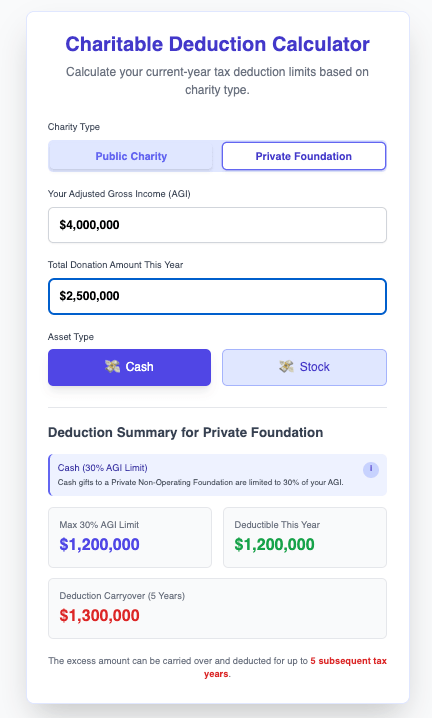
- Cash Contributions: Deductions for cash contributions to private foundations are generally limited to 30% of the donor’s Adjusted Gross Income (AGI).
- Appreciated Property: Contributions of long-term appreciated publicly traded securities to private foundations are generally limited to 20% of AGI. For non-publicly traded assets like privately held stock or real estate, the deduction may be limited to the cost basis rather than the fair market value.
- Non-Itemizer Deduction (Limited): Starting in the 2026 tax year, non-itemizing taxpayers can deduct up to $1,000 (single filers) or $2,000 (married couples filing jointly) in cash donations to *qualified public charities*. However, this specific non-itemizer deduction cannot be used for contributions to private foundations or donor-advised funds.
- Itemizer Deduction Floor: For individual itemizers, the OBBB establishes a new 0.5% AGI floor for charitable contributions, effective for 2026 and beyond. This means that deductions are only allowed for the aggregate amount of contributions that exceed 0.5% of the taxpayer’s AGI.
- Top Tax Bracket Deduction Cap: Taxpayers in the top federal income tax bracket will see their charitable deduction benefit capped at 35% per dollar donated, a slight reduction from the prior maximum benefit.
- Estate Tax Benefits: Assets contributed to a private foundation are typically excluded from the donor’s estate, thereby reducing or potentially eliminating federal and state estate taxes.
Excise Tax on Net Investment Income for Private Foundations (2026)
A significant change introduced by the OBBB for private foundations, effective for taxable years beginning after December 31, 2025, is the replacement of the flat 1.39% excise tax on net investment income with a new tiered system based on the foundation’s asset value. This tiered structure aims to impose higher rates for foundations with larger endowments, potentially reaching up to 10% for the largest organizations. The specific tiers are:
- Tier 1: Foundations with assets up to $50 million may pay a rate similar to the previous 1.39%.
- Tier 2: Foundations with assets between $50 million and $100 million may face a higher excise tax rate.
- Tier 3: Foundations with assets between $100 million and $500 million may encounter an even higher rate.
- Tier 4: The largest foundations, those with assets exceeding $500 million, may be subject to the highest rates, potentially up to 10%.
This excise tax, regardless of its specific tiered rate, continues to be considered a qualifying distribution for purposes of meeting the 5% minimum payout requirement.
Other OBBB Updates Affecting Nonprofits (2026)
The OBBB also includes:
- An expanded 21% excise tax on executive compensation exceeding $1 million. This tax, effective 2026, now applies to *all* employees-current or former-of a tax-exempt organization earning over $1 million, rather than just the top five highest-compensated employees.
- An increased State and Local Tax (SALT) deduction for itemizers, rising to $40,400 in 2026.
- The 60% AGI limit for cash contributions to public charities has been made permanent.
What Restrictions Apply to Private Foundations?
Private foundations operate under strict IRS regulations designed to prevent abuse and ensure charitable assets serve the public interest. Key restrictions and requirements include:
- Self-Dealing: This is one of the most heavily enforced and critical restrictions. It prohibits direct or indirect financial transactions between the private foundation and “disqualified persons,” which include founders, substantial contributors, foundation managers, and their family members. Examples of prohibited self-dealing include buying or selling property, lending money, furnishing goods or services, or providing excessive compensation. Violations can result in significant excise taxes and penalties.
- Minimum Distribution Requirement (5% Rule): Private foundations are generally required to annually distribute at least 5% of the fair market value of their non-charitable-use assets for charitable purposes. Failure to meet this requirement can trigger substantial excise taxes.
- Excess Business Holdings: Foundations and their disqualified persons are generally limited in the percentage of ownership they can hold in a business enterprise, typically 20%.
- Jeopardizing Investments: Foundations must not make investments that could jeopardize the carrying out of their exempt purposes. Investments must be managed prudently to preserve the foundation’s assets for its charitable mission.
- Taxable Expenditures: Certain types of expenditures are prohibited or require specific IRS approval to avoid being deemed “taxable expenditures,” which incur excise taxes. These include grants for non-charitable purposes, lobbying activities beyond insubstantial amounts, and any political campaign intervention.
- Lobbying and Political Activity: Private foundations face strict limits on lobbying activities and are absolutely prohibited from intervening in political campaigns for or against any candidate for public office.
How Are Grants Made by Private Foundations?
Private foundations typically fulfill their charitable mission by making grants to other organizations or, in some cases, directly to individuals. The process and requirements for grantmaking vary depending on the recipient:
- Grants to Public Charities: The most common form of grantmaking involves direct cash grants to other qualified public charities (501(c)(3) organizations). These generally count as qualifying distributions towards the 5% payout requirement. Foundations should verify the grantee’s tax-exempt status using IRS data.
- Grants to Individuals: Making grants directly to individuals is possible but subject to additional stringent IRS requirements to avoid being classified as “taxable expenditures”.
- Scholarships, Fellowships, or Similar Purposes: These grants require prior written approval from the IRS of an objective and nondiscriminatory procedure for selecting recipients. Alternatively, grants can be made through an intermediary public charity (like a school or university) which manages the program and selects recipients.
- Disaster Relief or Economic Assistance: Grants to individuals facing economic distress or affected by disasters typically do not require prior IRS approval, provided they are awarded fairly and without discrimination, and meticulous record-keeping is maintained.
- Artistic or Literary Achievement: Grants awarded for such accomplishments also generally do not require prior IRS approval, but robust record-keeping is crucial.
- Grants to Non-Public Charities or Foreign Organizations: Grants to organizations that are not public charities (e.g., certain foreign organizations or non-exempt entities) are subject to “expenditure responsibility” rules under IRC Section 4945(h). This regime requires the foundation to undertake a pre-grant inquiry, establish a written agreement with the grantee, monitor the use of funds, and report expenditures to the IRS. An equivalency determination (proving the foreign organization is equivalent to a public charity) can sometimes be used as an alternative to expenditure responsibility.
- Grants to Other Private Foundations: Generally, grants to other private foundations are not permitted without special safeguards, and they may not count as qualifying distributions in some scenarios.
Can Family Members Participate in a Private Foundation?
Yes, family members can and frequently do participate in the governance and operations of a private foundation. This is especially true for “family foundations,” which constitute a significant portion of all private foundations and are often run by multiple generations of the same family to achieve philanthropic goals. Involvement can include serving on the board of directors or trustees, managing assets, and participating in grantmaking decisions. However, the involvement of family members is subject to strict IRS self-dealing rules. While family members can receive reasonable compensation for actual services provided to the foundation (e.g., management, grant administration), such compensation must be documented, necessary, and consistent with market rates to avoid self-dealing penalties. They cannot be compensated merely for serving on the board or solely due to their familial relationship. Foundations must maintain objectivity and adopt clear conflict-of-interest policies to ensure decisions benefit the charitable mission and not disqualified persons.
Common Compliance Mistakes and IRS Updates
Private foundations must adhere to a complex set of federal rules, and non-compliance can lead to significant excise taxes, penalties, or even the loss of tax-exempt status. Common compliance mistakes include:
- Failing to Meet Minimum Distribution Requirements: Not distributing at least 5% of the fair market value of assets annually is a frequent error, which can incur a 30% excise tax on the shortfall.
- Mishandling Self-Dealing Transactions: Engaging in prohibited financial transactions with “disqualified persons” (including founders, family members, and managers) is a major risk, regardless of intent or perceived fairness. Penalties for self-dealing can be severe, starting at 10% of the transaction amount and potentially rising to 200% if uncorrected.
- Incorrectly Reporting or Misclassifying Grants: Errors in grantmaking, such as giving to ineligible recipients (e.g., other private foundations without appropriate safeguards), failing to obtain IRS pre-approval for grants to individuals, or neglecting expenditure responsibility for grants to non-public charities, can lead to taxable expenditures.
- Inadequate or Inaccurate Record-Keeping: Proper bookkeeping for all contributions, grants, investments, and expenses is a legal requirement. Inaccurate or incomplete financial records can lead to audits and penalties.
- Missing Filing Deadlines for Form 990-PF: All private foundations must file Form 990-PF annually. Missing this deadline or filing incomplete information can result in delays, fines, or audits.
- Underestimating the Complexity of IRS Rules: The intricate nature of private foundation regulations often leads organizations to inadvertently violate rules, highlighting the need for professional guidance.
- Failure to Monitor State and Local Requirements: Beyond federal regulations, foundations must also keep track of state-specific reporting and registration requirements.
Recent IRS Updates (One Big Beautiful Bill – OBBB)
As detailed in the “Tax Deductions” section, the One Big Beautiful Bill (OBBB), signed in 2025 and effective for the 2026 tax year, brought several key updates that private foundations and their donors nationwide should be aware of:
- Replacement of the flat 1.39% excise tax on net investment income with a new tiered system based on asset size, potentially increasing rates for larger foundations.
- Expansion of the 21% excise tax on compensation exceeding $1 million to *all* employees-current or former-of a tax-exempt organization, applicable to the entity rather than the individual.
- Introduction of a 0.5% AGI floor for itemized charitable deductions and a limited non-itemizer deduction that generally excludes private foundations.
These changes emphasize the ongoing need for private foundations to work closely with legal, tax, and accounting professionals to ensure continuous compliance and effective philanthropic impact.
Author: Sid Peddinti, Esq.
References
- Internal Revenue Service (2026) – Private foundations
- Beacon Nonprofit (2026) – Private Foundation Rules Explained
- Fidelity Charitable – What is a Private Foundation?
- Instant Nonprofit.Com Help Center – Intercom (2024) – Can Family Members Serve on the Board of a Private Foundation?
- Essential Tax Guidelines for Managing a Grant-Making Private Foundation (2022)
- Form 990 Filing requirements for Private Foundations.
- Wikipedia – Private foundation
- Internal Revenue Service (2026) – Definition of private operating foundation
- Fidelity Charitable – What is a Private Family Foundation?
- Internal Revenue Service (2026) – Types of foundations
- Common Compliance Mistakes Private Foundations Make (and How to Avoid Them) (2025)
- Internal Revenue Service (2026) – Grants by private foundations: Expenditure responsibility
- Wiss (2026) – Private Foundation Grants: Application and Compliance Guide
- Exponent Philanthropy – What are the rules for foundation grants to individuals?
- Forvis Mazars US (2026) – Five Private Foundation Pitfalls & How to Avoid Them
- Granite Harbor Advisors – The Benefits of Establishing a Private Foundation
- Oppenheimer.com – The Top 10 Advantages of Having a Private Foundation
- Council on Foundations – Family Foundations
- Holland & Knight (2025) – Navigating the One Big Beautiful Bill Act: Key Tax Changes for Exempt Organizations
- PKF O’Connor Davies (2026) – Private Foundation Compliance Risks and Penalties to Keep in Sight
- Goosmann Law Firm – Creating a Private Foundation
- Foundation Group® (2021) – Related Members on a Nonprofit Board of Directors
- Council on Foundations (2025) – H.R. 1 Tax Changes: How the One Big Beautiful Bill Affects Nonprofit Organizations in 2025
- Council on Foundations (2026) – One Big Beautiful Bill (OBBB): Impact on charitable giving
- IRS (2026) – EO operational requirements: Private foundations and public charities
- Council on Foundations (2026) – One, Big, Beautiful Bill: Impact on Philanthropy
- Fidelity Charitable – What It Costs to Start and Run a Private Foundation
- Greater Houston Community Foundation – Benefits of Starting a Private Foundation
- Baker Tilly (2021) – Private foundations overview: Considerations & qualifications
- Wiss (2026) – Starting a Private Foundation
- Foundation Group® (2026) – Overcoming Common Nonprofit Compliance Pitfalls
- Morgan Stanley – How to Set Up a Private Foundation: Essential Steps and Key Considerations
- American Endowment Foundation – Benefits of a Private Foundation
- Holland & Knight (2025) – Impact of the One Big Beautiful Bill Act on Tax-Exempt Organizations
- Templeton Advisors – 10 Common Self-Dealing Mistakes Private Foundations Make
- DAFgiving360 (2026) – What the One Big Beautiful Bill Act means for charitable giving
- Truist Bank – Starting a private foundation
- Wiss (2026) – OBBBA Tax Changes: What Nonprofit Leaders Need to Know for 2026
- American Endowment Foundation – Creating a Private Foundation
- TurboTax – Intuit (2026) – One Big Beautiful Bill: Charitable Deduction Changes for 2026
- Fidelity Charitable – The ‘Big Beautiful’ Tax Bill: What It Means for Your Giving Plans
- Foundation Source (2007) – New Operating Cost Benchmark Established for Private Foundations
This article is for informational and educational purposes only and is not intended as legal, tax, or financial advice. The benefits of private foundations and nonprofits depend on your specific financial situation and jurisdiction. Consult with a qualified legal and tax professional before making any financial decisions regarding foundations or charitable giving.
#WealthManagement #PrivateFoundation #GenerationalWealth #TaxStrategy #NonprofitTips #FamilyFinance #FinancialFreedom
 Law and Tax Magazine
Leave a comment