
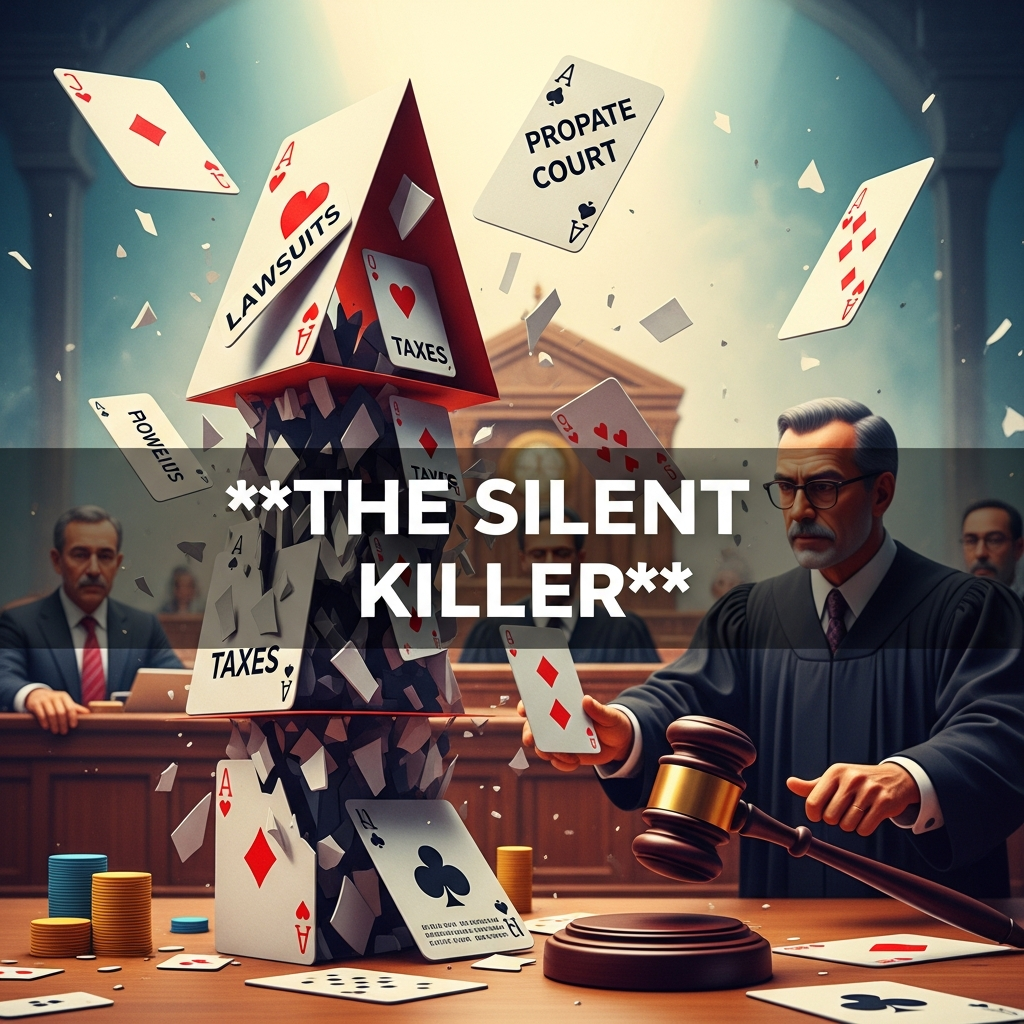
The difference between a thriving multi-generational enterprise and a bankrupt estate often comes down to a single decision made at the inception of the business: the legal structure. For most entrepreneurs, a business entity is viewed merely as a tax ID number or a formality required to open a bank account. In reality, the architecture of your business is the primary firewall between your family’s lifestyle and the volatile world of litigation, IRS audits, and the bureaucratic nightmare of probate court.
Choosing the wrong entity—or worse, operating without one—creates a “leaky” financial bucket. Every dollar earned is subject to unnecessary taxation, every contract signed carries a seed of personal ruin, and every success builds a larger target for predatory lawsuits. This guide outlines the mechanics of high-level entity design and why “strong architecture” is the only way to safeguard what you build.
⚡ Key Takeaways
- Sole Proprietorships are Hazards: Operating without a formal entity offers zero protection, leaving personal assets (homes, savings) exposed to business debts and lawsuits.
- The S-Corp Advantage: An S-Corp election is the most effective tool for reducing the 15.3% Self-Employment tax burden on small business owners.
- Asset Decoupling: High-level protection involves separating “safe” assets (real estate, IP) from “risky” operations (sales, service, labor) using a Holding Company structure.
- Probate is a Business Killer: Individual ownership leads to court-supervised asset freezes upon death. Coupling an LLC with a Living Trust ensures seamless succession.
- Anonymity Matters: Using states like Wyoming or Delaware can shield your name from public databases, reducing the likelihood of becoming a target for “frivolous” litigation.
Table of Contents
- The Financial Impact: Tax Leakage and the Wrong Entity
- The Liability Trap: Why DBAs and Sole Proprietorships Fail
- The Legacy Crisis: Probate and the Death of a Business
- Strong Entity Architecture: The Holding Company Model
- Comparison Table: Business Structures at a Glance
- The Gold Standard: LLC with S-Corp Election and Trust Ownership
- Frequently Asked Questions (FAQ)
- Call To Action & Next Steps
- References & Sources
The Financial Impact: Tax Leakage and the Wrong Entity {#the-financial-impact}
When an entrepreneur operates as a Sole Proprietor or a standard General Partnership, the IRS views the individual and the business as one and the same. This leads to a massive tax inefficiency known as the Self-Employment (SE) Tax.
Currently, the SE tax rate is 15.3% (covering Social Security and Medicare). For a sole proprietor earning $200,000 in net profit, the entire $200,000 is subject to this tax. This is in addition to standard federal and state income taxes.
The S-Corp Solution
By utilizing an LLC with an S-Corp Election, the owner can split their income. They pay themselves a “reasonable salary” (subject to payroll tax) and take the remaining profit as a “distribution.” Distributions are not subject to the 15.3% SE tax. In a scenario with $200,000 in profit, an owner taking a $70,000 salary could potentially save over $15,000 annually in taxes. Over a decade, that is $150,000 in lost wealth due simply to poor entity choice.
The Liability Trap: Why DBAs and Sole Proprietorships Fail {#the-liability-trap}
A “DBA” (Doing Business As) is not a legal entity; it is a nickname. It provides zero legal separation between your personal bank account and a business judgment.
Unlimited Personal Liability
In a Sole Proprietorship or General Partnership, you have unlimited personal liability. If a business vehicle is involved in an accident, if an employee commits an error, or if the business defaults on a lease, the creditor does not stop at the business’s door. They can legally seize your primary residence, your retirement accounts (depending on state law), and your children’s college funds to satisfy the debt.
Charging Order Protection
A strong entity like a properly drafted LLC provides what is known as “Charging Order Protection.” This means that if you are sued personally (for something unrelated to the business), a creditor’s ability to reach into the business and seize its assets is severely limited. Without a formal entity, this barrier does not exist.
The Legacy Crisis: Probate and the Death of a Business {#the-legacy-crisis}
One of the most overlooked risks of business ownership is Probate. If you own a business in your individual name, that asset must pass through a court-supervised process upon your death before it can be transferred to your heirs.
- Operation Freeze: Probate can take 6 to 18 months. During this time, bank accounts may be frozen, contracts cannot be signed, and employees may leave due to uncertainty.
- Public Exposure: Probate is a public process. Your business’s valuation, debts, and internal documents become a matter of public record.
- Loss of Value: Businesses are often sold at a steep discount during probate because they are seen as “distressed” assets.
The solution is to have the membership interest of the LLC owned by a Revocable Living Trust. This allows the business to bypass the court system entirely, ensuring the next generation takes over in days, not years.
Strong Entity Architecture: The Holding Company Model {#strong-entity-architecture}
Sophisticated asset protection moves away from the “all-in-one” model. Instead, it utilizes Asset Decoupling. This is the practice of separating high-risk activities from high-value assets.
1. The Holding Company
Usually a Wyoming or Delaware LLC, the Holding Company does not interact with the public. It does not sell products or hire employees. Its only job is to hold the “crown jewels”: real estate, expensive equipment, patents, and trademarks.
2. The Operating Entity
This is a separate subsidiary LLC that handles the “dirty work.” It signs the leases, interacts with customers, and employs staff. If the Operating Entity is sued, the plaintiff is limited to the assets within that specific entity. Because the valuable assets are tucked away in the Holding Company, they remain shielded from the Operating Entity’s liabilities.
3. Anonymity Shields
By using states with strong privacy laws (like Wyoming), an owner can use a “Registered Agent” to keep their name off the public Secretary of State website. This makes it difficult for “predatory” litigants and “skip-tracers” to link your personal wealth to your business entities.
Comparison Table: Business Structures at a Glance {#comparison-table}
| Feature | Sole Proprietorship / DBA | General Partnership | LLC (Standard) | LLC with S-Corp Election |
|---|---|---|---|---|
| Liability Protection | None (Unlimited) | None (Joint & Several) | High (Corporate Veil) | High (Corporate Veil) |
| Tax Efficiency | Low (Full SE Tax) | Low (Full SE Tax) | Moderate | High (SE Tax Savings) |
| Anonymity | None | None | Varies by State | Varies by State |
| Probate Avoidance | No (Requires Trust) | No (Requires Trust) | No (Requires Trust) | No (Requires Trust) |
| Ease of Setup | High | High | Moderate | Moderate |
| Audit Risk | Higher | Higher | Lower | Moderate |
The Gold Standard: LLC with S-Corp Election and Trust Ownership {#the-gold-standard}
For the modern business owner, the most resilient structure is a three-layered approach:
- The Foundation (The LLC): Provides the legal “veil” to protect personal assets from business risks.
- The Engine (S-Corp Election): Optimizes the tax structure to stop the bleed of self-employment taxes, allowing for greater reinvestment and wealth building.
- The Vault (The Living Trust): Owns the LLC. This ensures that the entire structure is “probate-proof” and remains a private family matter upon the owner’s passing.
This architecture creates a circular defense: it protects the business from the owner (personal lawsuits), the owner from the business (business lawsuits), and the heirs from the government (probate and estate delays).
Frequently Asked Questions (FAQ) {#faq}
Q: Can I just use a DBA until my business gets bigger?
A: This is a dangerous gamble. A single slip-and-fall or a breach of contract early on can result in a judgment that follows you for decades. The cost of an LLC is a small price for the “insurance” of personal asset protection.
Q: Is it hard to maintain an S-Corp?
A: It requires more administrative work than a standard LLC, including running payroll and filing a separate tax return (Form 1120-S). However, if your profit exceeds $60,000–$70,000, the tax savings usually far outweigh the administrative costs.
Q: Why do people use Wyoming LLCs?
A: Wyoming offers some of the strongest “Charging Order” protections in the country, low fees, and high levels of privacy for the owners (members) and managers.
Q: Does an LLC protect me from my own professional malpractice?
A: No. An LLC protects you from the liabilities of the business (debts, employee errors, slips and falls), but it does not shield you from your own personal negligence or professional malpractice. This is why professional liability insurance is still necessary.
Call To Action & Next Steps {#cta-next-steps}
Establishing the right entity is not a “set it and forget it” task. As your assets grow and your risk profile changes, your architecture must evolve. Failing to update your structure to include a trust or a holding company can leave your most valuable assets exposed to avoidable risks.
Subscribe to our master AI publication for daily legal, tech, and market insights. We provide the strategic intelligence you need to navigate the intersection of law and innovation.
Visit us at: www.peddintilaw.com
Article Contributed By:
Sid Peddinti, Esq. – Lawyer, Researcher, Publisher, AI Innovator
Website: https://www.peddintilaw.com
Keywords / Topics: #AI #LegalTech #Innovation #Publishing #FutureOfTech
References & Sources {#references-sources}
American Bar Association (ABA) – The Role of Revocable Living Trusts in Business Succession Planning
Internal Revenue Service (IRS) – Self-Employment Tax (Social Security and Medicare Taxes)
U.S. Small Business Administration (SBA) – Choose a Business Structure
Uniform Limited Liability Company Act (ULLCA) – Guidelines on Charging Orders
Wyoming Secretary of State – Business Division Privacy and Protection Standards
 Law and Tax Magazine
Leave a comment