

The Fast-Lane Guide: 5 AI Hacks for Law & Finance Pros to Create Content That Actually Gets Read
Look, we all know the drill. You’re a lawyer or a financial advisor. Your time is worth a fortune. But the firm – or your own brand – needs content. You need articles, blog posts, and those LinkedIn explainers that don’t sound like they were written by a robot reading the statute book.
You’ve got the knowledge, but you don’t have the hours to write 2,000 words on the ‘Implications of the new SEC Rule 14a-8’ or the ‘Tax Code changes for 2026.’
This is where AI saves your butt. It’s not about letting AI draft your sensitive documents (don’t be crazy). It’s about leveraging it for content creation – the stuff that builds authority, gets eyes on your firm, and drives new client calls.
We’re cutting the fluff. Here are the five most immediate, impactful AI shortcuts that top law and finance pros are using right now to pump out high-value, SEO-friendly content without turning into a full-time blogger.
Hack 1: The ‘Statute-to-Street’ Translator Shortcut: Turning Legalese into Google Gold
Your biggest content problem is using words people don’t search for. No one Googles “Hedge fund fiduciary duty violations.” They Google “My money manager ripped me off.” Your expert knowledge is great, but your language is a barrier.
The key is using AI to act as your Layman Term Translator. You paste in the boring, complex stuff, and the AI spits out the search-friendly headlines and simple explanations.
Key Action: The Audience-First Prompt
Use your favorite AI tool – like ChatGPT, Claude, or Gemini – and start with a strict prompt that defines the audience and the required tone.
Prompt Template:
“I am a financial advisor/corporate lawyer writing a blog post for a stressed-out parent with a $50k 401k balance, or a small business owner who just got a cease and desist letter. I need to explain [INSERT COMPLEX CONCEPT, e.g., ‘The difference between revocable and irrevocable trusts’ or ‘The core components of the new data privacy act’]. Take the following dense text and rewrite the main 5 takeaways using only 5th-grade vocabulary. The tone must be friendly and urgent.”
Takeaway: This forces the AI to cut out the jargon (like ‘indemnification’ or ‘amortization schedule’) and replace it with simple, high-search terms (like ‘who pays if you get sued’ or ‘how to pay off your loan faster’). It converts a complex topic into an SEO home run. This single hack transforms your content from an academic paper into a highly digestible article that ranks well.
You are essentially using the AI to do the tedious, market-driven work of simplification, which is crucial for capturing the massive, non-expert Google audience. This also addresses the compliance risk of sounding overly technical or offering specific advice, as the generalized, simplified explanation is a better fit for marketing purposes.
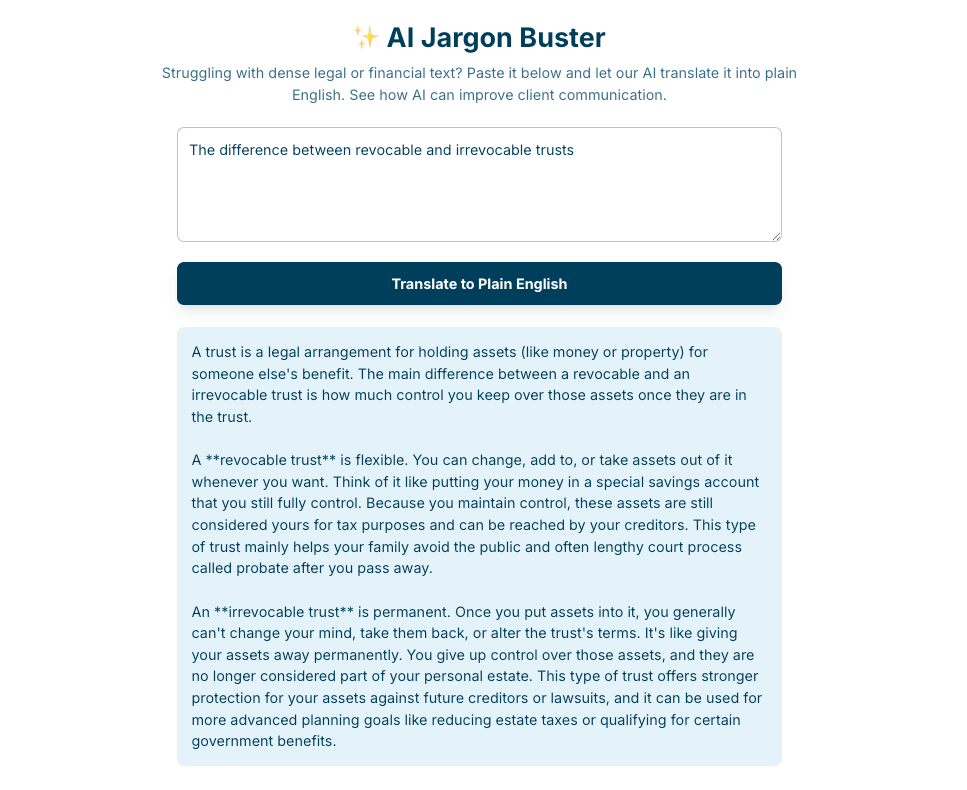
Here’s the example of an app that we built that does exactly that. You can see I’ve actually copied the sample text above “The difference between revocable and irrevocable trusts” into the app and the results it produced.
Imagine having a tool like this on your website – and also capturing the data that your potential clients or clients are actually typing in there.
Want to know what’s on your customer’s minds? Give them a tool to ask and then follow those questions down the path…
Want to install this “Legal & Finance Legal Mythbuster App” in your business – It’s already here – ready to go – book a call at the bottom and let’s chat.
Hack 2: The ‘SEO Sandwich’ Outline Generator: Hitting All Keywords Fast
Creating an article that ranks well is a formula: it needs a strong headline, specific subheadings that target keywords, and a good flow. Manually outlining a 1,500-word piece while trying to hit all 10 target keywords is tedious. AI does this in 30 seconds.
This hack uses AI to create the perfect “sandwich” structure: Introduction Hook (The Pain Point) – Meat (The Solution Steps) – Conclusion (The CTA).
Key Action: The Keyword Injection Prompt
First, decide on your main topic and gather 5-10 related keywords you want to rank for (e.g., ‘estate planning mistakes,’ ‘probate avoidance,’ ‘setting up a trust’).
Prompt Template:
“Generate a detailed 7-section blog post outline, designed for a financial blog. The article must be over 1,500 words and target readers who are new to investing. The topic is ‘7 Massive Rookie Mistakes That Are Killing Your Retirement Savings.’ Crucially, integrate these exact keywords into the main H2 and H3 subheadings: [LIST ALL 5-10 KEYWORDS]. Create a catchy, clickbait-style title that is less than 60 characters.”
Takeaway:
The AI now gives you the bones of a perfect article. You get the SEO-optimized structure immediately. All you—the expert—have to do is fill in the meat of each section with your verified, credible knowledge. This means you spend 90% of your time on the high-value, expert-only content, and 10% on the structural outline, rather than wasting hours formatting and keyword-stuffing.
For finance, this is especially useful for creating content series that link together, like ‘Mistake 1: Not Using a Roth IRA’ which can link to ‘Hack 3: Using an AI to Quickly Compare a Roth vs. Traditional IRA.’
Hack 3: The ‘Compliance Check & Tone Shift’ Revisor: Sounding Smart, Not Like a Robot
Law and finance content must be accurate. Period. You can’t compromise on that. But once you’ve written your technically perfect paragraph, it often sounds dry and lifeless. The “Compliance Check” is the most crucial content hack for your industry.
You write the accurate, technical draft. The AI then handles the tricky part: making it sound human, without altering the substance of the compliance-sensitive facts.
Key Action: The Two-Step Revision Prompt
Step 1: Write your accurate, expert paragraph on, say, the disclosure requirements for a Reg D offering or a new class-action waiver clause.
Step 2: Paste the text into the AI with a revision prompt.
Prompt Template (Law Example):
“I need you to act as a viral Reddit content writer. Take the following text, which is legally accurate, and rewrite it to have a conversational, slightly urgent, ‘I’m talking to my friend’ tone. DO NOT change the core facts or the technical accuracy. Focus on making it punchy, using short sentences, and adding an engaging opening line. The goal is engagement, not drafting a contract.”
Prompt Template (Finance Example):
“I have this paragraph about the risk profile of high-yield bonds. Rewrite it for a TikTok video script—no more than 90 seconds of reading time. Replace all complex financial terms with simple analogies. Example: ‘Volatility’ becomes ‘a roller coaster ride.’ Ensure the underlying meaning about the risk-reward tradeoff remains 100% accurate.”
Takeaway: You maintain total control over the credibility (the technical facts) while offloading the readability (the tone and flow) to the AI. This is a game-changer for speed. It also minimizes the ethical risk, as you are providing the verified truth, and the AI is only modifying the packaging.
It allows your firm to adopt a modern, viral-ready voice without compromising the professional rigor that your clients pay for. Think of it as having a highly creative copywriter on staff who never asks for a salary, but you still have to approve every final version.
Hack 4: The ‘One-Click Content Cluster’ Generator: Never Run Out of Ideas
The biggest content killer is the “What do I write next?” problem. You write a great piece on ‘Why a Will Isn’t Enough.’ Then you stare at a blank screen for a month.
Smart content marketing relies on “Content Clusters” or “Pillar Content.” This is a big article (the Pillar) supported by 10-15 smaller, related articles (the Clusters) that all link back to the Pillar. AI can generate an entire year’s worth of content ideas in a single prompt.
Key Action: The Pillar-to-Cluster Prompt
Pick one of your core services or a recent piece of legislation—that’s your Pillar.
Prompt Template:
“My firm specializes in small business litigation (the Pillar). I need 15 individual blog post ideas—each under 750 words—that are highly specific, easy to rank for, and target business owners who have never hired a lawyer before. Each idea must solve a common, simple problem. Title each one with a question (e.g., ‘Can I fire an employee without cause?’). List the 15 titles and a two-sentence summary for each.”
Takeaway: You get an entire editorial calendar instantly. You have the main idea (Pillar) and all the surrounding, easily digestible pieces (Clusters). This keeps your blog fresh, creates a web of internal links (which Google loves for SEO), and establishes your firm as the definitive source for that specific niche.
For a finance pro, the Pillar might be ‘Understanding the 5 Asset Classes,’ and the Clusters would be ‘What is a Bond?’ ‘Why Stock Prices Move,’ etc. It turns a single topic into a professional, systematic content strategy. This ensures consistent output, which is the secret sauce for improving search rankings over time.
Hack 5: The ‘Repurpose Power’ Transformer: 1 Article Becomes 5 Pieces of Content
You’ve finally written that killer 2,000-word article on ‘The New AML Regulations’ or ‘How to Handle an IRS Audit.’ Awesome. Now, don’t let it die on your blog. The fastest way to maximize your content ROI is to instantly repurpose that single article into multiple formats for different platforms.
AI can instantly turn a long article into a PowerPoint, a LinkedIn post, and a series of Tweets, saving you hours of manual cutting and pasting.
Key Action: The Platform-Specific Prompt
Take your verified, 2,000-word piece of content and paste it into the AI.
Prompt Template:
“I have this 2,000-word article about [Paste Article Here]. I need three different pieces of content derived from it.
- A LinkedIn post (300 words max) using a bulleted list, focusing on a personal, urgent call to action.
- A series of five separate Tweets/X Posts, each under 250 characters, using relevant emojis and ending with a hashtag.
- A five-slide PowerPoint outline (Title and three main points per slide) for a client webinar on this topic.
The key facts must remain exactly the same as the original article.”
Takeaway: This is the ultimate efficiency hack. You’re no longer just writing one blog post; you’re generating five unique pieces of marketing material from one effort. Your one hour spent writing is now 5x more effective.
This allows your firm to dominate multiple social channels (LinkedIn, X, Email Newsletters) with professional, high-authority content, all while maintaining the strict factual accuracy you started with. This repurposing speed is what separates firms that are merely present online from firms that genuinely dominate search results and social feeds.
This AI shift is not about replacing the expert; it’s about amplifying the expert. Your brain has the certified, nuanced knowledge. The AI has the speed and the vocabulary to talk like a human and rank high on Google.
By outsourcing the speed and simplicity to the machine, you are left to focus on the accuracy and credibility—the only things that truly matter in law and finance. Start with these five hacks and watch your content production—and client inquiries—skyrocket.
So, what’s the big takeaway? Your expertise is gold, but if it’s buried in jargon, it’s worthless for marketing. Use AI as the translation engine that converts your complex knowledge into simple, high-impact content. Which of these five hacks are you going to try first this week—the ‘Statute-to-Street’ Translator or the ‘One-Click Content Cluster’? Drop a comment below and let me know how it goes! If you want to dive deeper into how to integrate these high-speed AI systems into your professional workflow without the compliance nightmares, you need to check out the full guides we have waiting for you right now at https://aitechincubator.com.
Cheers,
Sid Peddinti, Esq.
Researcher, IP Lawyer, AI Innovator
The content provided in this article is for informational and content strategy purposes only and should not be considered legal, financial, or tax advice. Always review AI-generated content for factual accuracy, compliance, and professional ethics before publication. Consult with a qualified professional for specific advice tailored to your situation.


 Law and Tax Magazine
Leave a comment